Audio description in galleries and museums aims to make visual information accessible using verbal description. The Photographers' Gallery has, for several years, also linked audio description to slow looking and to visual literacy.
The audio files for an introduction to the exhibition and five audio descriptions for five works in the exhibition are below. A transcript of each audio description is also available.
These audio descriptions have been produced by Eleanor Margolies, a writer and audio describer. She has a background in puppetry and theatre design, with interests in ecology and the role of the senses in performance. She audio describes in museum, theatre and dance contexts.
About Japanese Women Photographers: From 1950s to Now
This landmark exhibition rewrites the story of Japanese photography through the eyes of women. Japanese Women Photographers spotlights the work of 27 groundbreaking artists, from the 1950s to today, whose perspectives have shaped how Japan sees itself, and how it is seen by the world.
Spanning identity, pop culture, fashion and everyday life, the exhibition celebrates internationally renowned Japanese women photographers, alongside those who have long been overlooked. The result is a powerful rebalancing of a history too often told through a single, male-dominated lens.
OKANOUE Toshiko, White Bouquet (1955)
Influenced by Max Ernst, OKANOUE Toshiko crafted her collages by cutting out material from magazines such as Time, Life, or Vogue. This was both an artistic and a pragmatic choice. After the war, Japan faced a scarcity of paper and other raw materials, and the occupation by US forces made it easier to find Western goods. OKANOUE’s practice was the most inventive intersection of photography and surrealism in postwar Japan. Her significance today lies not only in her formal inventiveness but in how her collages prefigure later critical engagements with media, desire, gender, and the visual aftermath of war. They make her a compelling predecessor to later generations of Japanese artists who interrogate image culture and identity.
OKANOUE has said of her approach:
“The ingredients are glue, a pair of scissors, and your fingertips.”
Transcript
This black and white collage in portrait format is assembled from photographs cut from magazines , creates surprising juxtapositions and a distorted sense of space.
In the bottom right-hand corner, a woman leans away from us arching slightly to the right, head thrown back, holding her face in both hands. We are below, looking up at her – one of her elbows touches the corner of the image, while the other seems to jut out towards us. She’s wearing a sleeveless white nightdress with ribbon threaded through the bodice, and the low angle and square neckline emphasise the vulnerability of her neck. The pose suggests a still from a horror movie – a endangered heroine looking up at something awful. But for each of her eyes, the artist has glued cut out photographs of pocket watches.
Directly above the woman’s head, in the upper right-hand section of the image, a pair of disembodied hands in white gloves with lace cuffs are placed so that they appear to hold a large paper-wrapped bouquet of white tulips. Is this floating bouquet – referred to in the title – what the woman might find so terrifying?
Between the woman and the bouquet, in the centre of the image, two playful pale-furred kittens leap, with their front paws reaching up as if towards the bouquet, and their rear legs outstretched as they float in mid-air. Their limbs oddly echo the bare arms of the woman.
In the background, receding away from these figures, there is a corridor leading to an open doorway. The doorway is entirely filled by a sky with clouds, evoking the surreal paintings of Magritte. The corridor has a shiny wooden floor, the narrow strips of parquet running towards us, but the walls might be exterior walls, with one arched niche holding a fragment of a word in capital letters ...RTHEA.., as if it’s an advert for a theatre or shop.
The composition of the image – a figure holding its face in the foreground, while the background recedes to a point on the horizon - strongly recalls the composition of Edvard Munch’s 1893 painting ‘The Scream’, but with some important differences, such as the perceived gender of the figure, the angle of the lines of perspective (going off to the right in ‘White Bouquet’, and to the left in ‘The Scream’), and most importantly OKANOUE’s use of black and white found photographs from magazines, rather than paint and colour. Some collage artists rephotograph their work to conceal the technique, but in this work by Okanoue, the cut edges of the magazine images are visible.
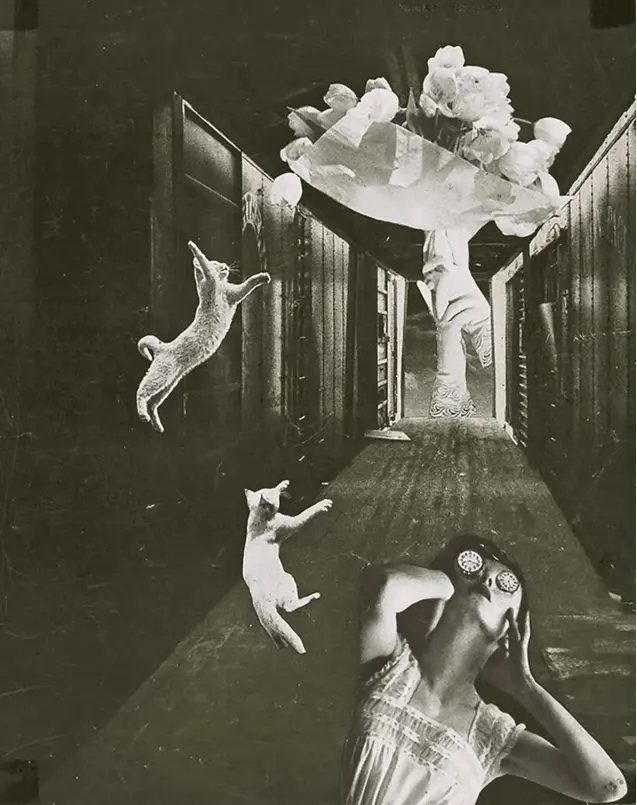
OKANOUE Toshiko, White Bouquet (1955) Collage, Courtesy of the Wilson Centre for Photography
ISHIUCHI Miyako – ‘Apartment #50’ (1977-78)
ISHIUCHI Miyako (b. 1947) interrupted her design and textile studies at Tama Art University, Tokyo, in the mid-1970s, to devote herself to photography. She began her photographic career in Yokosuka, her hometown and the site of a major US military base after World War II. ISHIUCHI was also involved in uman ribu, the women’s liberation movement in 1960s Japan. Her photographs blended personal and political perspectives as she documented the presence and traces of the occupation. Throughout her career, ISHIUCHI has focused on recording the material traces of the passage of time.
She has said of her work:
“I am interested in the shadows rather than places in full light, the muddy rather than limpid stream, minor motives rather than major. I believe that time flows beautifully in such things.”
Transcript
This black and white photograph in landscape format depicts the corner of a room, with two umbrellas hanging from a washing line strung between two adjacent walls. Strips of dark wood divide the white-painted walls into sections, with one slim timber running down vertically where the two walls meet in the centre of the photograph. To the left is a sliding window divided horizontally into three sections. The lowest rectangle is frosted and the upper two sections are clear glass. However, the space behind the glass is dark, so the glass is reflective, like a blurred mirror. The window has a small metal handle halfway up. It’s one of a pair of sliding windows, both pushed across to leave an opening to the left, with darkness beyond it.
Above and below, the wall is white, as is the section of wall to the right of the window. It’s enclosed by a wider strip of dark wood, perhaps a door frame, running down the right-hand edge of the photograph. A small dark rectangle about 10cm by 5cm that sits alongside the frame is presumably the plate for a light switch or electrical socket.
The washing line runs from a nail stuck in the centre of the upper frame of the window to the door frame, drawing a curved arc across the top of the photograph. A stovetop tin kettle hangs from the same nail, angled slightly awkwardly against the window. In the centre, hanging against the white wall, the two umbrellas are hooked over the line. One umbrella has a geometric pattern and a striped border, while the other is slightly larger, with a chunky handle, and is plain black. The handles are turned in opposite directions, but the umbrellas lean against each other slightly. To the right of the umbrellas, a pair of heavy rubber gloves is folded over the line.
The umbrellas are positioned so that they can drip into a white sink that’s at the very bottom of the photograph. The sink has holes drilled for hot and cold taps, but a single tap is mounted in the wall above it.
The print is grainy, emphasising the textures of the materials: the wood on the doorframe is dark and glossy, reflecting the light but also showing the grain, while the wood framing the window is bleached in some areas. Darker smudges on the white wall alongside the electrical panel and above the sink could be grubby marks or just shadows.
The care taken with the wet umbrellas, the implication of tea-making and cleaning, as well as the companionable position of the umbrellas all suggest a particular kind of human presence in a room that otherwise speaks of living with little money to spare.
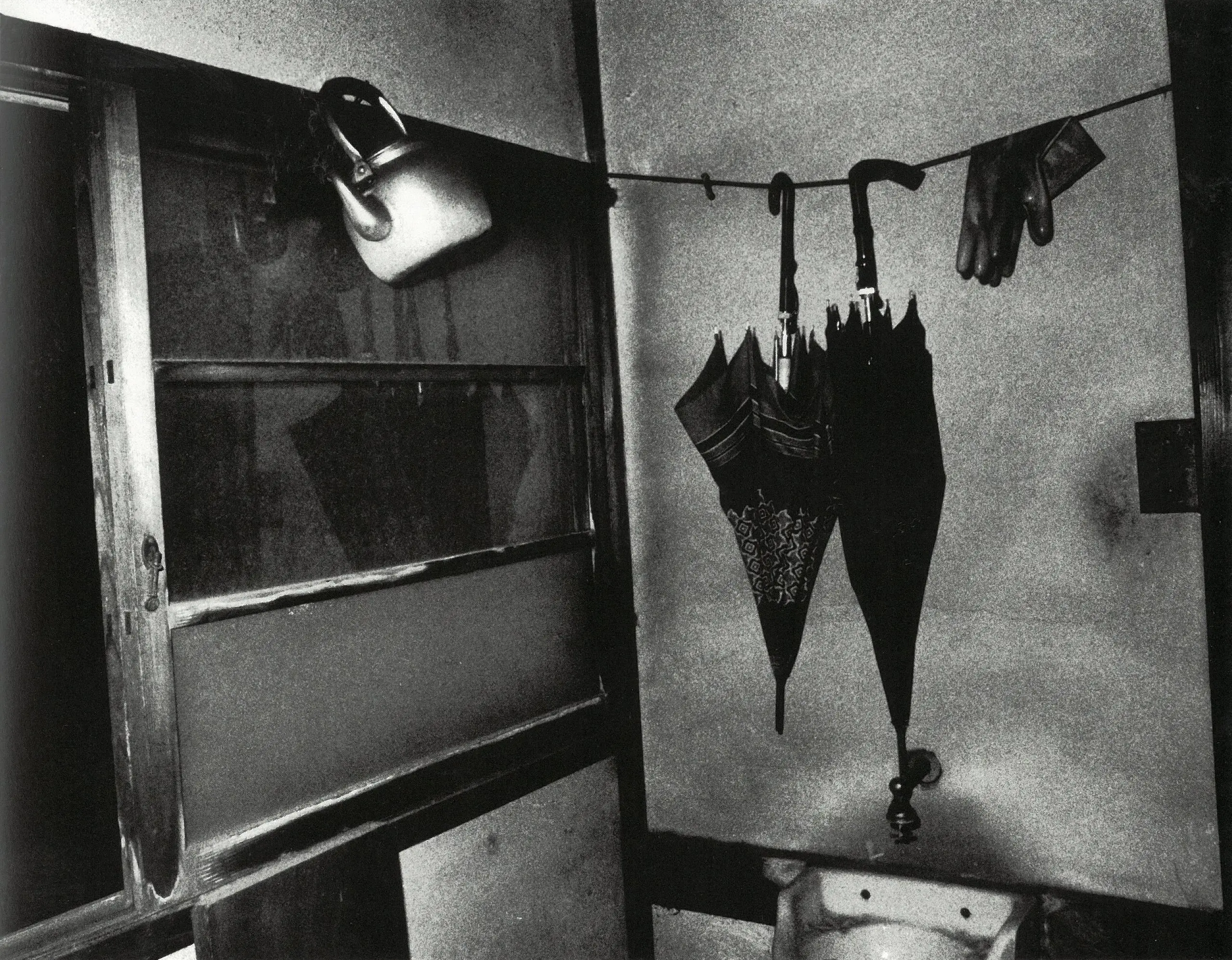
ISHIUCHI Miyako, Apartment 50 (1978) Courtesy Third Gallery Aya, Osaka
SAWADA Tomoko – Untitled from the series OMIAI♡ (Matchmaking♡) (2006)
SAWADA Tomoko first came to prominence with her series ID400 (1998) where she used a photobooth located in the parking garage of a Kobe supermarket. She created four hundred unique characters, each with their own personal style. She stresses identity as something produced through external codes rather than internal essence.
Her photographic work is primarily made up of serial self-portraits that combine typological conceptualism and role-play. Using makeup and costumes, posing in photobooths or studio settings, SAWADA interrogates the smothering rules of conformity and feminine beauty.
SAWADA has said of her work:
“I am interested in the relationship between what is seen on the outside and what is inside (...) but it is important to understand that these images are not an expression of myself personally but an exploration of the way we classify people—typologies.”
Transcript
These two colour images by SAWADA Tomoko are self-portraits, both from her series OMIAI – which means ‘matchmaking’. In both Japanese and English, the title is printed with a heart after the word. The work refers to the studio portraits used in matchmaking.
SAWADA is posed against a smooth, neutral studio background in which the floor becomes the wall. The studio lights cast a heart-shaped shadow on the backdrop.
In the first photograph, SAWADA appears as a young woman, perhaps in her twenties, in a pale peach kimono decorated with whitepointed flowers. Her feet just peep out below the hem, showing white tabi socks made with a split toe to fit into traditional sandals called geta; they have a flipflop style thong attached to a red lacquer wooden base. Her hands are folded in front of a wide belt called an obi, in a brighter red, also decorated with stylised flowers. She wears a matching flower in her hair, which is in a shoulder-length bob with a straight fringe, the strands very slightly clumped rather than perfectly smooth. Her half smile seems as carefully positioned as her hands. The choice of pink clothes, haircut and meek pose all contribute to make her appear very young, even childlike.
In the second photograph, SAWADA appears as a woman in her thirties or forties. She’s very carefully made up, with luminescent white foundation, thin drawn-on eyebrows and perfect flicks of eyeliner. Her lips have been outlined to form a cupid’s bow and filled with a deep red matt lipstick. Her black hair is swept away from her face in a smooth wave and put up at the back of her head.
Her kimono is a vivid blue with an abstract pattern of curving white lines as the background to a floral motif of white daisies and orange and yellow chrysanthemums. The neckline is trimmed in golden yellow and her wide obi is of the same yellow silk, with a circular motif of foliage edged in orange. The obi is held in place with a knotted cord and seems to be stiff, as if it is keeping her upright and rigid. Beneath her kimono hem, the wooden geta sandals have a stylish pattern of triangles in turquoise, black and orange, toning with the kimono.
SAWADA is seated on a wooden bench upholstered in brocade, her knees together and turned modestly to one side, one hand on her lap, one on the bench. Her fingernails are painted a coral red that picks up the orange of the chrysanthemum on the kimono. Beautifully composed, this prospective bride appears slightly wary, gazing out at the viewer without a smile.
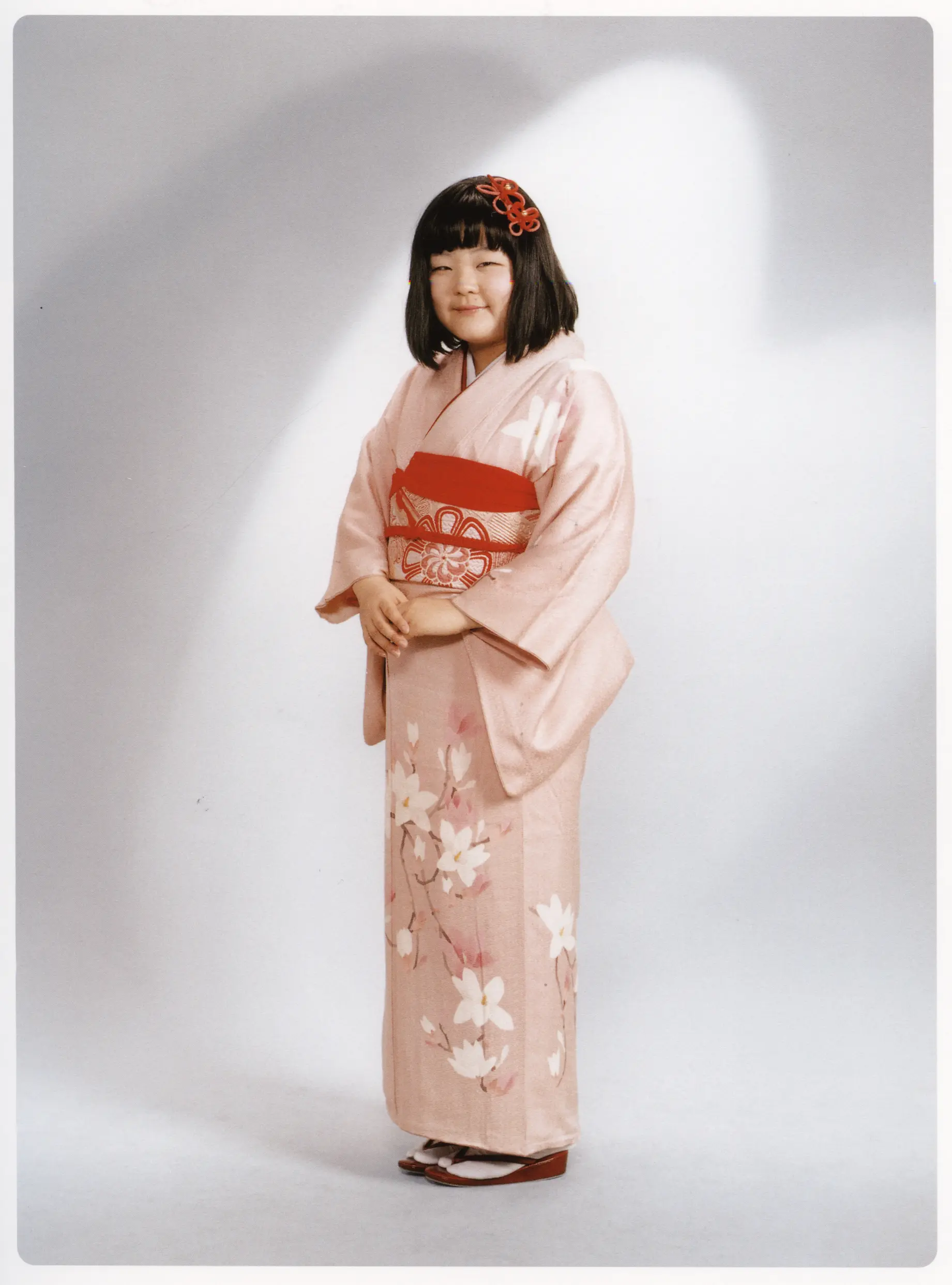
SAWADA Tomoko, Untitled from the series OMIAI♡ (Matchmaking♡) (both 2006) Courtesy of the artist and ROSEGALLERY, Los Angeles
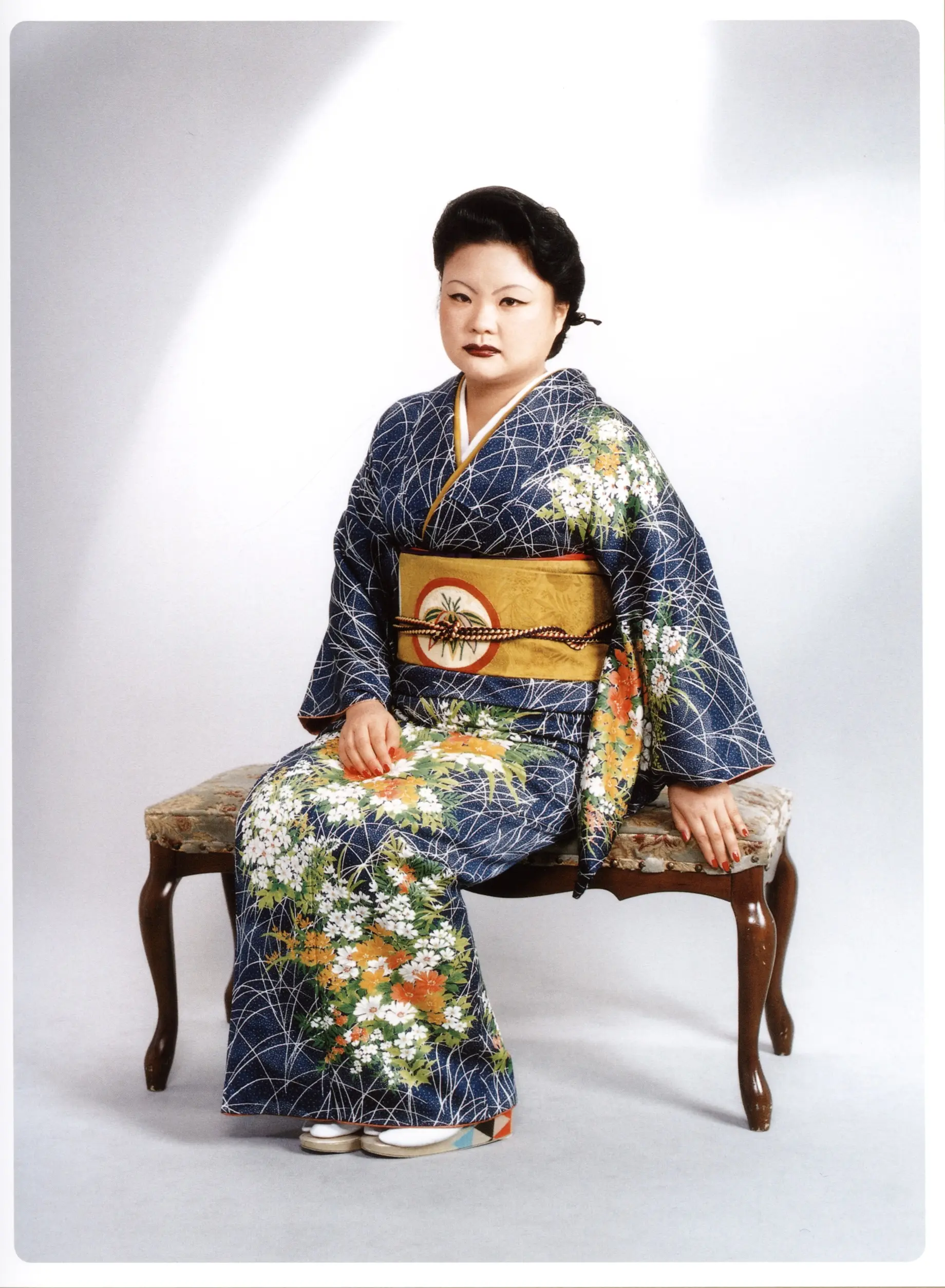
SAWADA Tomoko, Untitled from the series OMIAI♡ (Matchmaking♡) (both 2006) Courtesy of the artist and ROSEGALLERY, Los Angeles
KATAYAMA Mari, Shell (2016)
KATAYAMA Mari creates works, departing from hand-sewn objects and extending to photography, video, and installation, as a practice of ascertaining the society, social roles, and landscapes that are interwoven and resonating in multiple layers. Her hand-sewn objects appear repeatedly, changing in form and function, in each self-portrait series, thereby making the norms and gazes inherent in society visible. In the making of photographs, KATAYAMA always releases the shutter herself: by engaging with the relationship of ‘taking/being taken,’ she examines the boundaries and dynamics between the self and the other. Using settings constructed with mirrors or her own room as the stage for photography, KATAYAMA reflects not only on relationships and frictions, but also on the world and the structures that lead to them. Through these processes, she questions the nature of boundaries: the relation between ‘I’ and ‘you,’ what constitutes ‘correctness,’ and where the line between ‘natural’ and ‘artificial’ lies.
Transcript
This colour photograph in square format is a riot of texture and patterned textiles, mainly in black and cream, with touches of subdued red and sparkles of diamante and fairy lights. It’s a self-portrait and the artist sits in the centre, looking out at us with a serious expression from under a sharply cut black fringe.
The artist has black bobbed hair; her eyes are outlined in black and she wears deep plum lipstick and nail polish. She’s wearing lingerie – a body with thin shoulder straps and lace on the bodice in oyster-coloured silk that blends with the colour of her arms and skin. As a user of prosthetic legs, KATAYAMA’s left leg ends above the knee and her right leg above the ankle. A thin black cable runs across her thighs leading to a shutter release in her right hand.
KATAYAMA has said that when shooting self-portraits, she always uses a cable release or timer. Her long-held motto is “pressing the shutter myself.” She says: “‘This reflects my intention to flatten the power dynamics inherent in the act of photographing—between the one who takes and the one who is taken. Using a film camera, without digital editing or multiple exposures, and capturing each image in a single shutter release is a way of inscribing time and bodily position directly into the work.”’
The artist sits on a two-seater sofa that’s barely visible under mounds of fabric – it has an ornate carved wooden frame and dark purplish brocade upholstery. Sitting alongside her on the sofa, to the left, is a life size soft sculpture of a woman wearing a black corset decorated with eye-shaped parts adorned with sparking beads, her legs the same lengths as those of the artist. The woman is made of a patchwork of white lace pieces, embellished with rows of shells of different shapes and sizes. She leans her head back on a black and white checked cushion and hugs two cuddly toys – a dalmatian with black spots on white fur, like a negative version of the bodice. The dalmatian in turn hugs a fluffy cream-coloured cat. Like Katayama, the sculpted woman has pink fingernails.
To the left of the sofa, an opening in a wall and table are draped in cream lace, with a table lamp shaded by sparkling glass pendants. There’s a patchwork cushion in soft pinks and greens, and glimpses of other hand-sewn sculptures, including a pair of hands, made with stitched leather pieces.
Behind the sofa, a tall unit with eight shelves holds dozens of lidded glass jars of various sizes that are filled with oil. Each jar is labelled with a particular date and time and contains remnants of things KATAYAMA ate or used. The shelves and contents are partially hidden by a curtain of fine black threads resembling hair. To the right of KATAYAMA is a roll of cream fabric covered with many eye-shaped lace parts and a dressmaker’s dummy covered by a patchwork of different shapes pieced together on it.
Both KATAYAMA and the sculpture of the woman rest their right legs on another life-size soft sculpture of a human figure, running from left to right, lying on the wooden floor. The surface of the sculpture is covered by various elements like shells, beads and artificial hair that are seen through an organza fabric. Two stuffed fabric hands rest near the ‘head’ end, to the right, and in the foreground, close to us, there is a pair of white prosthetic feet. To the left, two prosthetic legs lie on the floor. The shins are functional bars of shiny unadorned metal, but the upper leg is modelled in cream plastic, and decorated with hand-drawn foliage and butterflies, rather like tattoos. The feet of the prosthetic legs wear Mary Jane shoes with double straps.
The shutter release cable crosses the black cord of a string of fairy lights that seems to enclose the whole scene, running behind KATAYAMA’s right leg and twinkling either side of it, picking out the shoes on the prosthetic legs, and running along the glass jars on the shelves, making them sparkle as if they contain diamonds.
The photograph is surrounded by an ornate gold frame which is hand-decorated by KATAYAMA with a line of seashells and glittery white stones and pearl beads.
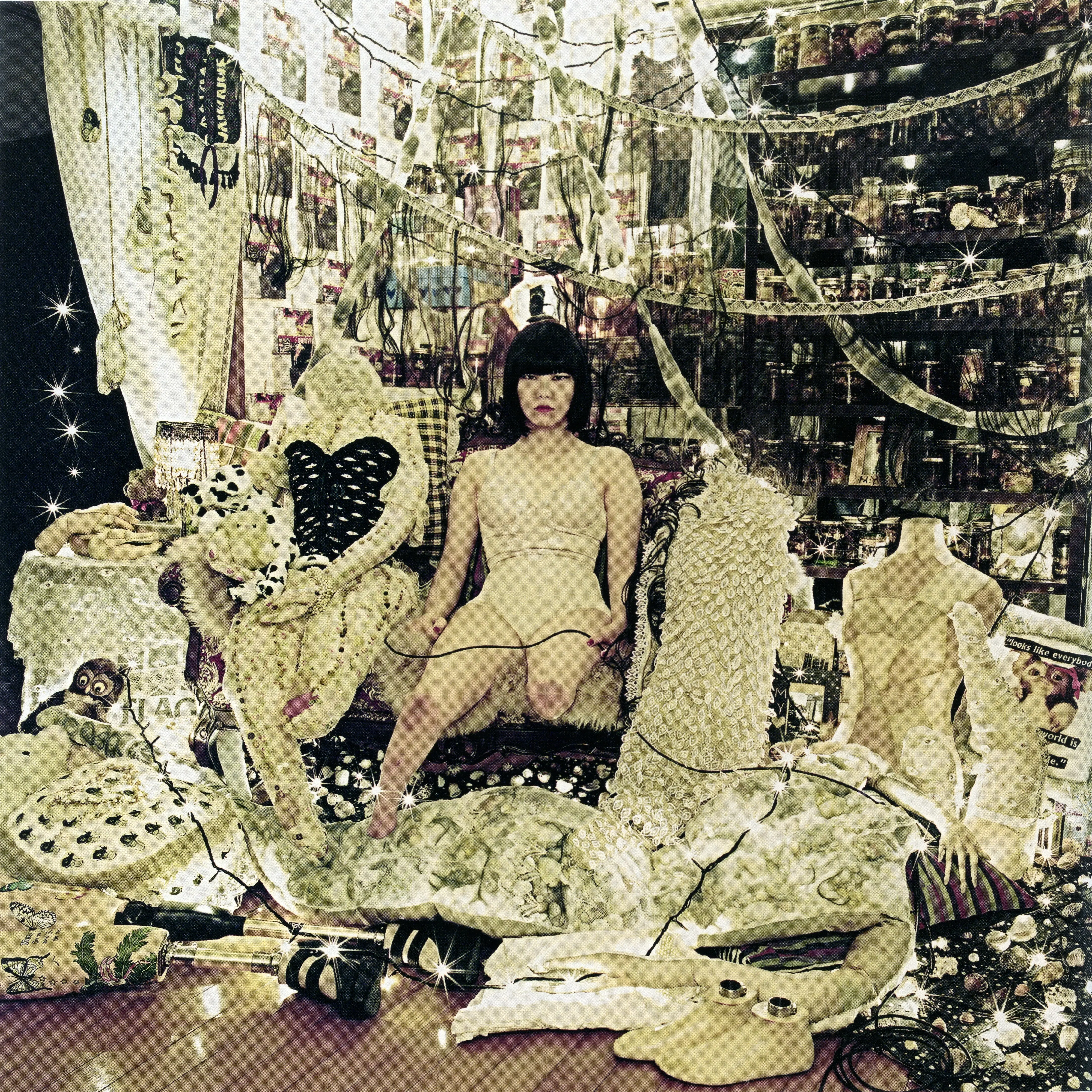
KATAYAMA Mari, Shell (2016) Courtesy the artist
KON Michiko, Bones and Tutu (1995)
KON Michiko (b. 1955) first gained recognition in the 1980s for her unique black-and-white still lifes. She quickly became known for her surreal images that reimagine everyday objects—a hat, a dress, a brassiere—using organic elements such as fish, vegetables, flowers, or insects. The constructions are both mundane and dreamlike, introducing elements of sensuality into the everyday and speaking to both life and death. KON is known for creating surreal, meticulously constructed still lifes that blend the real and the uncanny.
She has said of her work:
“Rather than making work that leaves people feeling nothing, I’d prefer to be creating the kind of work that disgusts people and makes them want to laugh.”
Transcript
At a casual glance, this black and white, portrait format photograph shows a short ballet tutu laid out on a dark background and surrounded by shuttlecocks. But closer examination reveals a surreal assemblage.
The skirt is made up of the silvery white backbones of fish, laid out like the overlapping layers of thin tulle fabric. Two more skeletons form the shoulder straps of the tutu, while the bodice is a made up of short lengths of backbone studded with two dozen fish heads, the eyes gleaming like jewels. Most of the heads are scattered randomly, but round the neckline they are lined up, side by side, like a shining necklace.
Arching above the tutu, more or less where the dancer’s head might be, there is a whole fish, the flesh and head still intact. Although the shape of the fish doesn’t resemble a human head at all, there is a muscular vitality to the curving body that suggests the graceful movement of a dancer’s neck or arm.
The tutu is surrounded by seventeen white shuttlecocks. Each shuttlecock is made up of white goose feathers set into a round white tip, held in place by a contrasting dark band and forming a conical shape that echoes the shape of the tutu in miniature. Most of the shuttlecocks are directed towards the top right-hand corner of the photograph, but a few are heading to the left, while one just above the bodice and one below the skirt of the tutu point downwards.
The whole assemblage is set out on a dark background with a pale floral pattern, like a luxurious wallpaper.
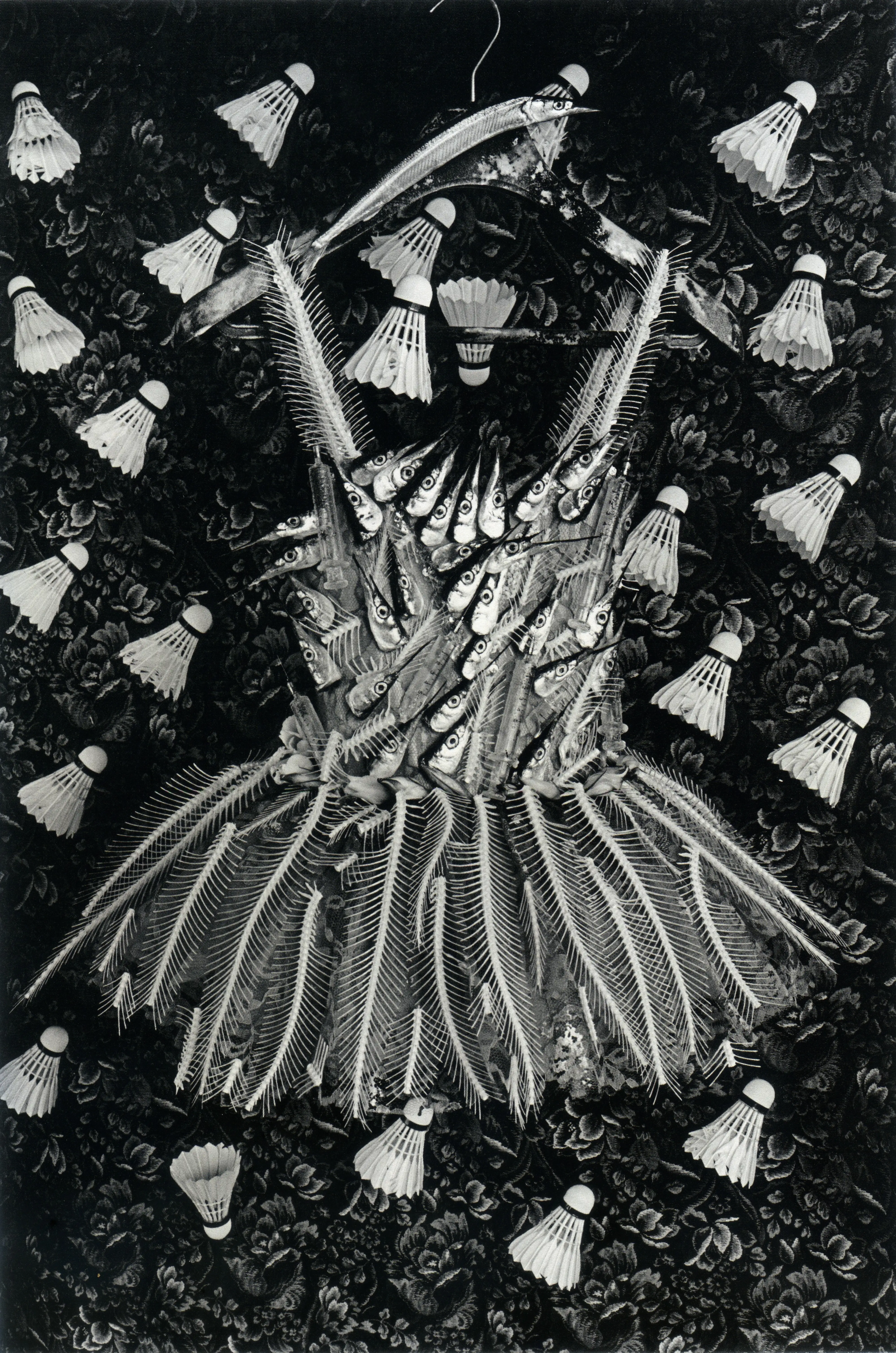
KON Michiko, Bones and Tutu (1995) Courtesy PGI gallery, Tokyo