Audio description in galleries and museums aims to make visual information accessible using verbal description. The Photographers' Gallery has, for several years, also linked audio description to slow looking and to visual literacy.
The audio files for an introduction to the exhibition and five audio descriptions for five works in the exhibition are below. A transcript of each audio description is also available.
These audio descriptions have been produced by Eleanor Margolies, a writer and audio describer. She has a background in puppetry and theatre design, with interests in ecology and the role of the senses in performance. She audio describes in museum, theatre and dance contexts.
About William Eggleston: All that goes unnoticed
Marking the 50th anniversary of William Eggleston's landmark exhibition and book William Eggleston's Guide (1976), this exhibition offers a fresh perspective on one of the most influential photographers of the twentieth century.
A pioneer of colour photography, Eggleston (b.1939, Memphis, USA) is renowned for combining everyday observation with an intuitive sense of colour and composition. William Eggleston: All that goes unnoticed brings together many of his iconic works, alongside lesser-known images. Declaring himself as ‘at war with the obvious’, Eggleston’s democratic way of seeing redefined colour photography and transformed how the ordinary could be represented.
Transcript
William Eggleston: All that goes unnoticed
William Eggleston was born in Memphis, Tennessee in 1939. He transformed the possibilities of colour photography by turning his attention to ordinary life. During the 1960s, when colour was still strongly associated with advertising, magazines and amateur snapshots, he began using it as a vital part of artistic photography. Working mainly in and around the southern United States, he photographed family and friends, domestic interiors, ordinary objects, suburban streets, cars, diners, petrol stations and road signs.
Eggleston photographed the people, places and social environment he knew intimately, yet he has rarely explained the meaning of his images. Most of his photographs remain untitled, sometimes identified only by a location, leaving us to look closely for clues about the relationship and circumstances they depict.
At first, his images appear simple. Look longer, and they become stranger. Unexpected viewpoints, unusual compositions and intense colour combinations disrupt our expectations. Common objects and situations take on unusual importance: a child's tricycle becomes monumental; a ceiling oddly fills the entire frame; a man smoking a cigarette in a kitchen looks like an actor on a film set.
This exhibition focuses on the period when Eggleston developed the visual language for which he became known. It begins with his early black-and-white work before exploring his experiments with colour and the photographs that led to the photobook William Eggleston's Guide and his influential 1976 exhibition at the Museum of Modern Art in New York. From there, it expands into the journeys, commissions and publications that followed through to the mid-1990s.
Eggleston's photographs have also circulated far beyond the gallery wall. Books, magazines and record covers displayed throughout the exhibition show how his images have been edited, reproduced and encountered in different contexts, reaching audiences outside the world of photography. In Europe in particular, they helped shape an enduring visual idea of Americana, influencing how generations of photographers, musicians and filmmakers imagined the United States. Together, these different forms reveal the influence of Eggleston's visual language across art and popular culture.
This exhibition is curated by Julia Bunnemann and Jose Neves from The Photographers' Gallery. The exhibition is on from 14 October 2026 to 21 February 2027.
Large-print guides are available on request at the Front Desk.
Visit tpg.org.uk to find out about talks and events related to the exhibition.
Taking photos or videos of the exhibition? Share them with us and tag @thephotographersgaIlery
1. Untitled, Huntsville, Alabama, 1970
Transcript
Untitled, Huntsville, Alabama, 1970
In this colour photograph, a man in late middle age sits on the end of bed in a hotel room. His body is in profile, facing toward the left side of the photograph. His head and shoulders are slightly turned toward us. He is in the centre of the photograph, but occupies less than a tenth of the image, which is dominated by the textures and colours of the room’s surfaces.
The walls of the room are painted in mustard yellow, floor to ceiling, with a deep red fitted carpet. The low ceiling is covered in greyish polystyrene tiles. The door to the room is a double-leaf construction for sound-proofing - and it stands with both leaves open flat against the wall, like the covers of a book. They’re also mustard yellow, with a pattern of squares. A low cabinet stands against the left-hand wall, with a small suitcase open on top of it. There’s a framed passage of printed text on top of the cabinet. The text is not legible.
The double bed is covered in a pale gold bedspread with a synthetic sheen. On the near side, the fabric is slightly pilled and it doesn’t hide the bulge of the unevenly tucked in sheets.
The bed stands against a mustard yellow partition wall. There’s a wide opening in the partition wall, leading to an alcove furnished with a dressing table, with a large sheet of mirror glass on the wall and a fluorescent light above it. Presumably, a wardrobe opens off one side of the alcove and an ensuite bathroom off the other.
The man is in his late fifties or sixties, with a bald pate and neatly trimmed black hair and pouchy cheeks. He wears a white shirt and black trousers. He appears weary, his shoulders rounded, and he cradles a glass in both hands between his knees, as if he’s just arrived at the hotel and poured himself a drink after a long journey.

William Eggleston Untitled, Huntsville, Alabama, 1970, from the Wilson Centre for Photography © Eggleston Artistic Trust, courtesy of the Eggleston Artistic Trust and David Zwirner
2. Untitled, Memphis, 1971
Transcript
Untitled, Memphis, 1971
This photograph shows a woman in a royal blue dress sitting on a low wall. In the background, there is a wide suburban street with single-storey houses and trees just coming into spring leaf, including a sprinkling of pink cherry blossom.
The woman is white, in middle age, with strawberry blonde hair brushed up and away from her face in a bouffant style. She looks directly at the photographer, with her lips slightly pursed to accentuate her cheekbones. The cut and material of her blue minidress is very much in the fashion of the period, shiny and streamlined, with short sleeves and a high funnel collar. She’s groomed and poised, with a heavy line of false eyelashes, pearly fingernails and a large ring with a blue stone. Her legs are crossed and she has a stack of papers resting on her knee.
One could imagine this woman in an advert for office furniture but she is instead rather incongruously perched on the low wall that separates the tarmac of a front drive from some scrubby grass. She is centred in the lower half of the image. To the left, the drive slopes up away from us with the wall turning to the left exactly halfway up the photograph. To the right of the woman, there is a metal post with a few metres of chain wrapped around it and padlocked to itself - presumably the chain can be stretched across the entrance to the drive.
The section of wall nearest the street is painted egg yolk yellow, while the rest is white. The paint is peeling and the wall has a crack in it, with a few weeds growing at the base. Perhaps the woman is an estate agent, with a property to sell? Her left hand is raised, slightly blurred in movement, as if she is about to speak.
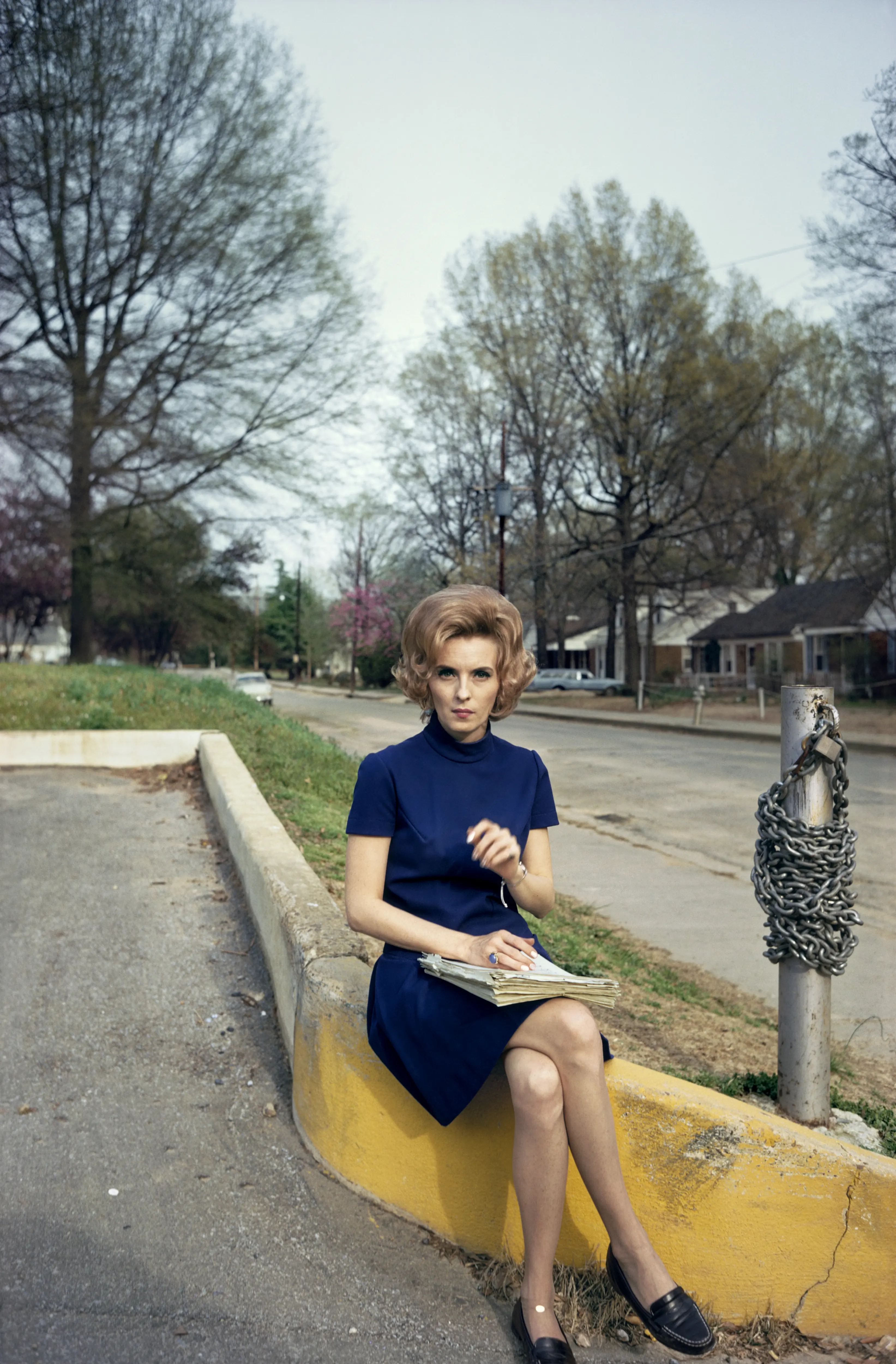
William Eggleston, Untitled, Memphis, 1971, from the Wilson Centre for Photography © Eggleston Artistic Trust, courtesy of the Eggleston Artistic Trust and David Zwirner
3. Untitled, Las Vegas, c.1971-74
Transcript
Untitled, Las Vegas, c.1971-74
This photograph shows a man sitting, slightly hunched over, at a pinball machine. He’s in his fifties, with his dark hair cut short at the sides and grown out in a longer wavy section on top, as if he once had an Elvis-style quiff. He wears a mustard yellow polo shirt.
The five pinball machines in the photograph are all chunky glass and metal boxes, framed by yellow strips of metal. They are similar in size and colour, but with slight variations. They have vertical back panels decorated with cartoons, slogans and coloured boxes that can light up. One shows a cartoon of a baseball game, along with coloured buttons containing written words and numbers, all in vivid turquoise, blue, yellow and red. From the back panels, sloping glass table-tops run down to about waist level, as the players sit on high stools.
Just below this horizontal glass surface, there is a colourful maze that the pinball has to navigate, with illuminated flippers set around it that the players can control with buttons. Even the machines that have no players sitting in front of them are illuminated with dozens of small white lights, glowing colours and reflections. The flashing of lights, and the constant sound of ringing and chiming, of metal springs and rattling metal balls are almost palpable in the photograph.
The photograph is taken from behind the left shoulder of the man in yellow, giving the feeling that we might be leaning in to watch his game, or about to sit down at the next machine. The man’s thumb is jammed into one of the two buttons on the lower front face of the machine but he’s turning to the left, eyebrows raised, his expression serious and unsmiling.
To his right, at the next pinball machine, a younger man is engrossed in his game. He wears a pale blue chino shirt. His posture is the same as that of the older man and his dark hair is cut in a similar way around the ears - although much shorter overall. Could they be father and son - or is it just that the conventional male fashions and the way they interact with the pinball machines make them seem to resemble each other?
At the far end of the room, to the right, a blurred male figure with his back to us browses shelves holding VHS tapes with brightly coloured covers, all facing outward. It’s not clear if we’re in a Las Vegas arcade which also offers videos for sale, or in a video shop which has a bank of pinball machines.
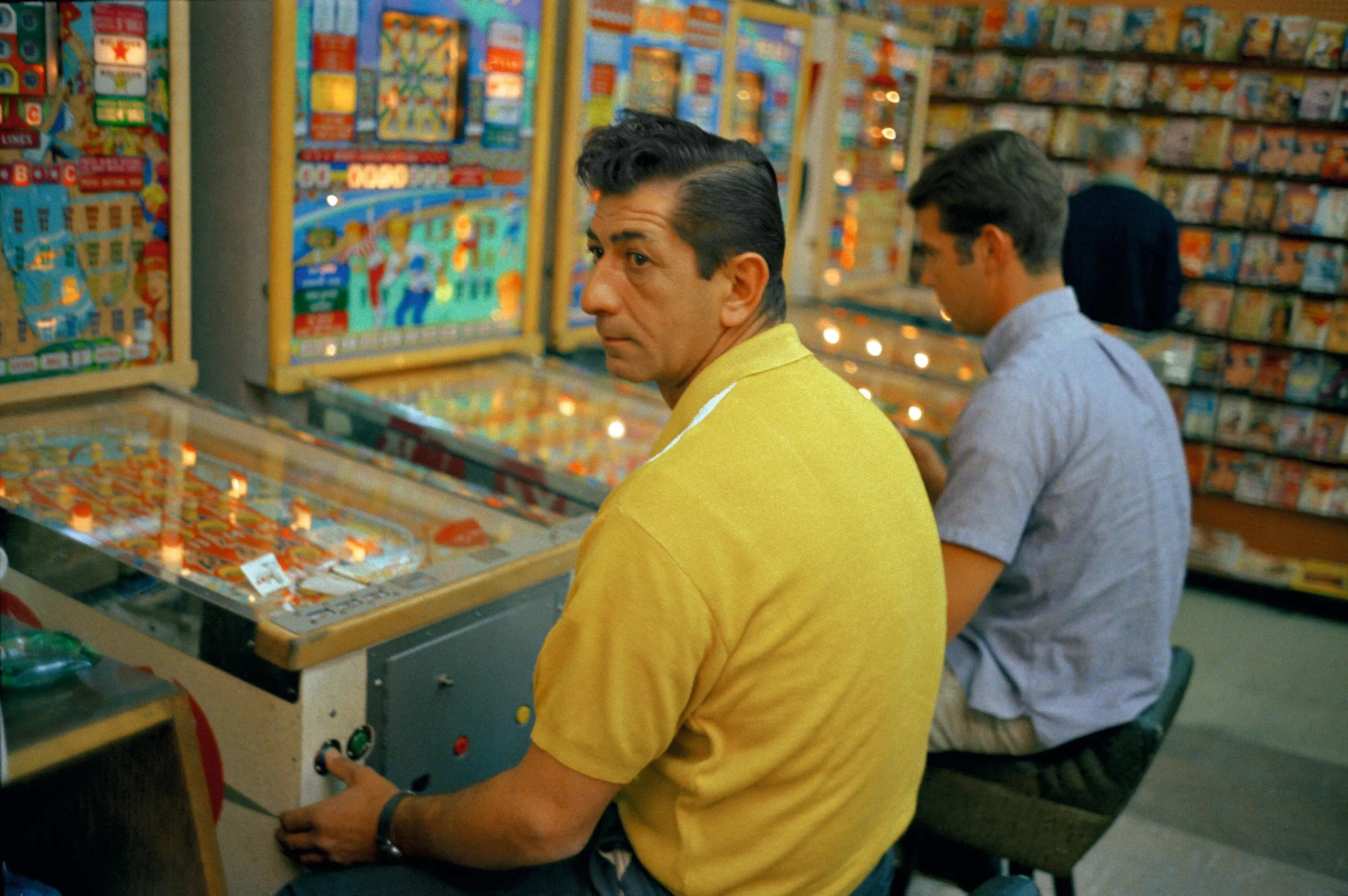
William Eggleston, Untitled, Las Vegas, from the series Los Alamos, c.1971-74, from the Wilson Centre for Photography © Eggleston Artistic Trust, courtesy of the Eggleston Artistic Trust and David Zwirner
4. Untitled, (Liquor store at night), c.1960-72
Transcript
Untitled, (Liquor store at night), c.1960-72
This black and white photograph shows a brightly lit liquor store in the inky blackness of the night. The store stands alone, angled in the photograph so that a concrete pillar on the corner of the building runs down the centre of the image, with the glass frontage facing to the left, and a brick side wall to the right. The store floats like a bright island on a tarmac parking lot.
It’s a single-storey building, with a wavelike concrete roof with two arches over the store itself, and half arches forming covered areas over the sides. A narrow border of raised paving runs around the building, so that one could drive right up to it and climb out at the side, sheltered by the arcade roof. A line of neon stars follow the jaunty line of the roof. Standing on top of it, between the two arches, there is a giant neon bottle, nearly as tall as the building itself at 3 metres high. The bottle is outlined in white light, with a series of arrows chasing down to a pair of glass entrance doors. Lettering on each door reads ‘The Bottle Shop’, in a vintage nineteenth-century typeface, suggestive of the Wild West. The street number 1397 appears on the glass above each door. The roof arching over the side wall is topped by giant illuminated letters spelling out the word LIQUOR. On the wall below, there is an illuminated advert for Bourbon Supreme: The Better Bourbon. A more informal message on the window, in a 1960s-style lower-case font, reads: We’re glad you’re here.
Contrasting with the clean lines of the modernist architecture, the windows are busy with cardboard displays framing bottles, and slogans for various brands. Inside, the store’s walls are lined with shelves stocked with bottles. A cardboard cut out of a matador advertises YAGO Spanish table wine.
To the left of the photograph, a patch of white light suggests the entrance to a neighbouring shop that’s closed for the day. The liquor store stands alone in the darkness - an inviting beacon of light and playful design.

William Eggleston, Untitled, (Liquor store at night) , c. 1960-72, from the Wilson Centre for Photography © Eggleston Artistic Trust, courtesy of the Eggleston Artistic Trust and David Zwirner
5. Untitled, Memphis, from the series Los Alamos, c.1971-74
Transcript
Untitled, Memphis, from the series Los Alamos, c.1971-74
This colour photograph is a close up of the exterior of a fast food restaurant, showing a section of the serving window, a narrow shelf below it and the wall of the building.
The photograph is vertically divided in two with a wide stripe of bright red paint running down the side of the window and continuing to the wall beneath the shelf. To the right of this stripe, the dirty white wall of the building dissolves out of focus, with some grubby patches and a few weeds growing up against the wall from the ground.
Another stripe is painted on the wall under the shelf, to the left of the long stripe, giving the impression that the red and white vertical stripes might continue along the wall.
The sliding window of the serving hatch is closed and its frame is painted a deep, dusky blue. A blurred reflection in the window appears to be of a brightly lit sign. Sunlight streams onto the wooden opening of the interior serving window. Taped to the window, from the inside, is a photo illustration of what appears to be a thick, square hamburger on a white bun on a paper plate.
The shelf beneath the window is made of speckled formica, somewhat battered. A cruet holder made of metal wire sits to the right of the shelf. It holds glass shakers for salt and pepper and, in the centre, two plastic squeezy b ottles of ketchup, bright red with white nozzles. The photograph is taken from an angle in which the two scarlet bottles are perfectly lined up with the painted stripe on the wall. The red of the ketchup dissolves into the red of the painted stripe.
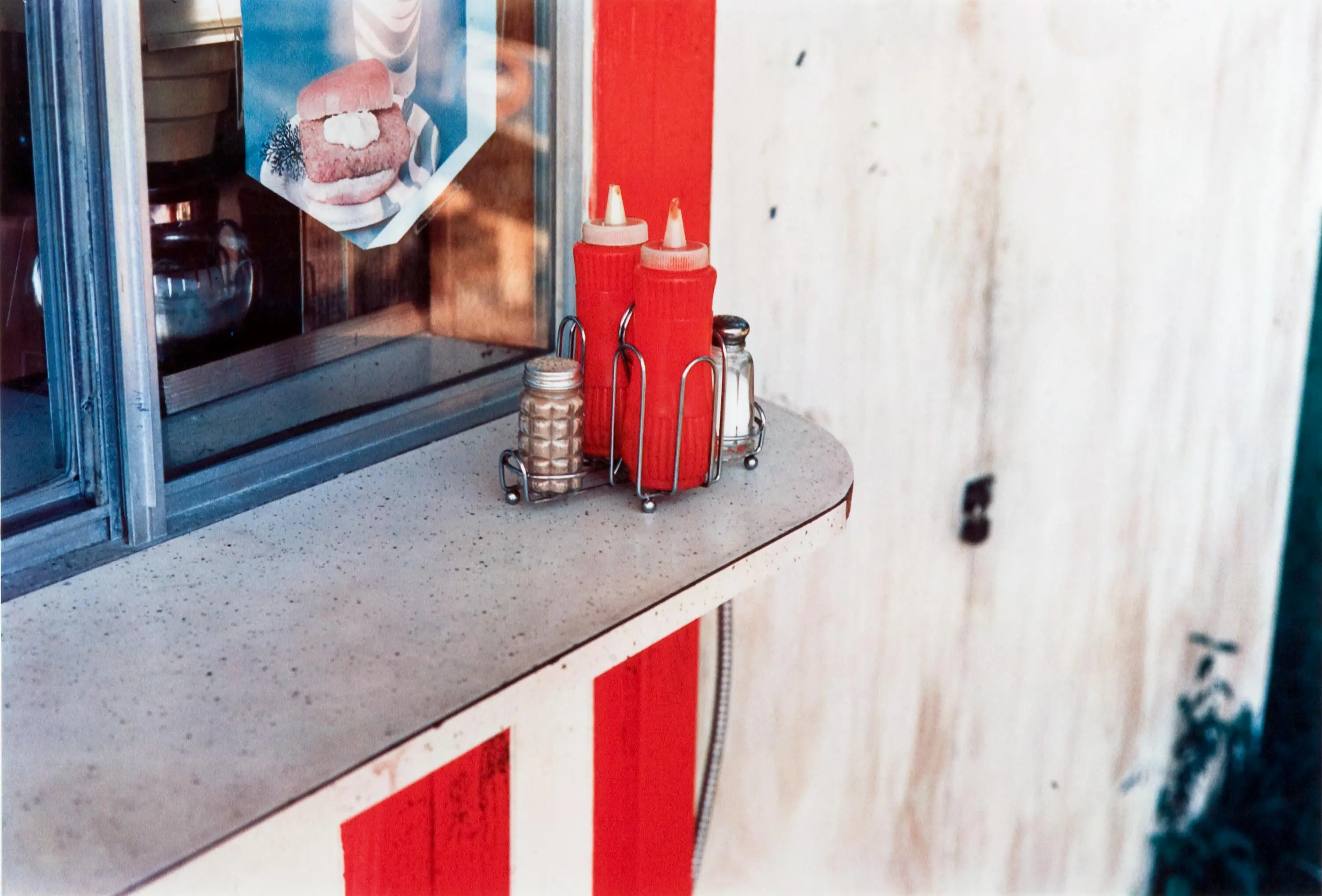
William Eggleston, Untitled, Memphis, from the series Los Alamos, c. 1971-74 from the Wilson Centre for Photography © Eggleston Artistic Trust, courtesy of the Eggleston Artistic Trust and David Zwirner


