Audio description in galleries and museums aims to make visual information accessible using verbal description. The Photographers' Gallery has, for several years, also linked audio description to slow looking and to visual literacy.
The audio files for an introduction to the exhibition and five audio descriptions for five works in the exhibition are below. A transcript of each audio description is also available.
These audio descriptions have been produced by Eleanor Margolies, a writer and audio describer. She has a background in puppetry and theatre design, with interests in ecology and the role of the senses in performance. She audio describes in museum, theatre and dance contexts.
About Zofia Rydet: Sociological Record
This landmark photographic project by Zofia Rydet is a sweepingly comprehensive documentary portrait of Polish domestic life which spans decades, eras, regions and cultures.
From 1978, when she was 67, Zofia Rydet (1911-1997) set out to photograph the inside of every Polish household. She would approach a home unannounced, knock, and warmly introduce herself and ask the people living there if they would like to take part in her project.
Rydet was always on the road, with a camera in her hand. For nearly three decades, she photographed people in their homes, still lives, building exteriors and landscapes. She also returned to the same houses several years after she first visited to document the transformation of rural Poland. The result – Sociological Record – is a monumental project and one of the most important achievements in 20th century Polish photography.
Totalling nearly 20,000 negatives, only a fraction of the Sociological Record images were printed in Rydet’s lifetime. Over 100 prints are on show at The Photographers' Gallery, alongside books and personal letters.
Transcript - Introduction
Zofia Rydet was born in 1911 in Stanisławów, Galicia – the city was at that time part of the Austro-Hungarian Empire, later became part of Poland and is now in Ukraine. Her family fled to Upper Silesia at the end of the war and Rydet set up a stationery shop in Bytom. She became one of the few women members of the Gliwice Photography Society, where she met other avant-garde photographers, became a photography teacher and began sending her photographs to international and national competitions.
Sociological Record was her final and largest artistic project. Starting in 1978, at the age of 67, she set out to capture ordinary, unsung populations, particularly of the countryside but also in towns and cities. Approaching unannounced, Rydet would knock on doors and warmly introduce herself. Using a newly acquired wide angle lens and flash, she was able to capture the often dark interiors in great detail, asking her sitters not to smile and look straight ahead into the camera lens. Her subjects are posed in their homes, rich in personal histories. As the series progressed, Rydet identified sub-categories such as ‘Women on Doorsteps’, ‘Professions’, ‘Road Signs’ and ‘Televisions’. She also identified more philosophical themes such as ‘Presence’ – noting the omnipresence of the image of the Polish Pope John Paul II – and ‘The Myth of Photography’, focusing on the significance of family photographs, such as hand-coloured wedding portraits. Rydet created over 20,000 images for Sociological Record; it is a monumental project and one of the most important achievements in 20th century Polish photography.
Transcript - Chochołów, Podhale, 1982
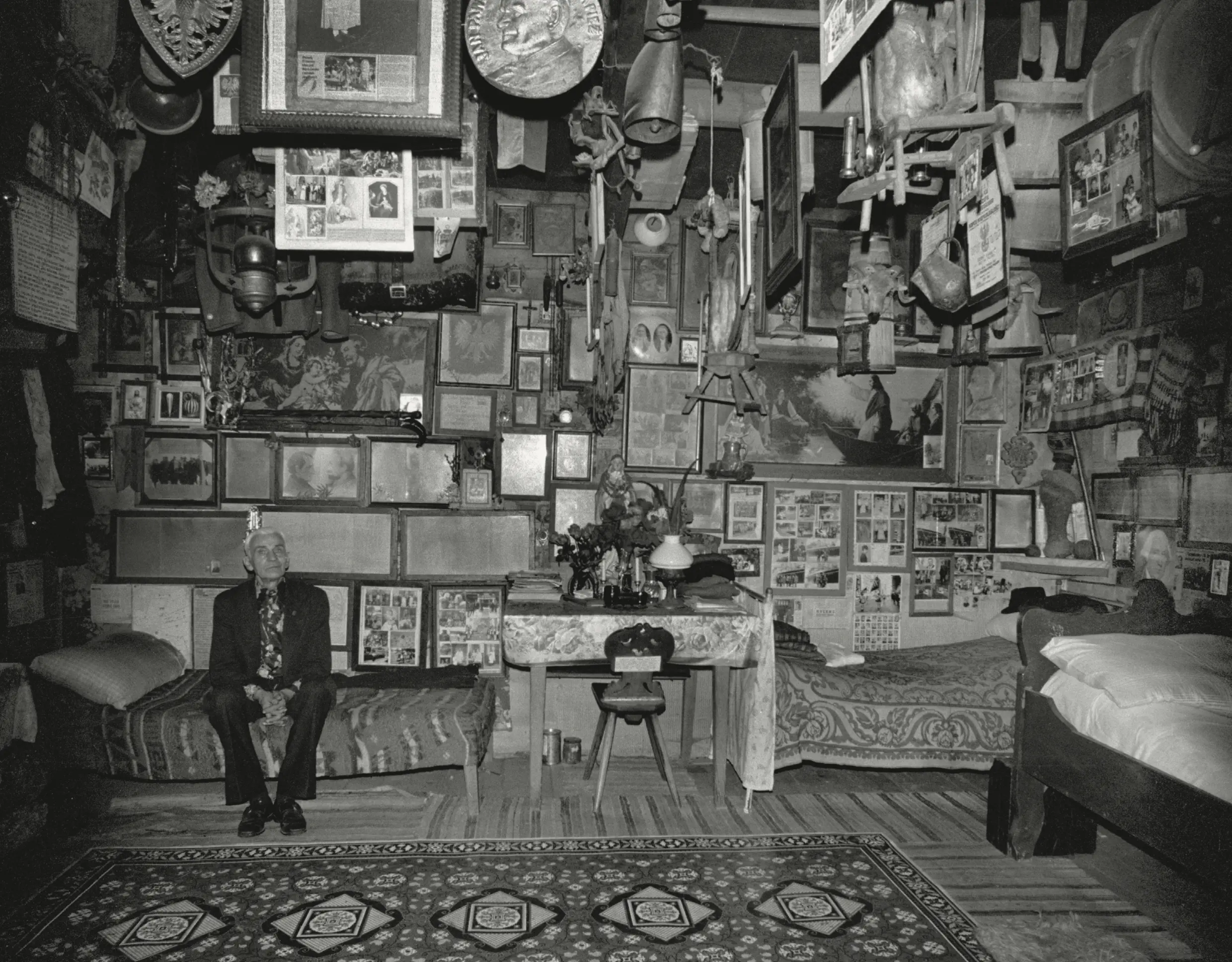
In this black and white photograph which has been blown up to nearly life size for the exhibition, an older man sits on a bed, facing us, in a large open room with the walls and ceiling completely lined with framed images and objects.
The man is tall and slim, and appears to be in his seventies, with white hair swept back from his forehead in a widow’s peak. He wears a dark suit over a shirt with a bold print, and shiny black shoes. His hands are interlaced between his knees and his chin is lifted, with a hint of a smile on his lips.
The photograph has been taken with the help of flash, and the corners of the image are in shadow, while the centre is brightly illuminated. The floor is covered with layers of rugs suggesting bright colours that cannot be seen in the black and white photograph: a patterned Persian carpet in the centre lies on top of several striped rugs. Items of furniture are set against the walls of the room. From left to right, these are: a low bed covered in a striped blanket, on which the old man sits, with a large square pillow with a checked cover at one end; In the centre of the wall, a small table covered with a flowered oilcloth is completely buried under objects: a statuette of the Virgin Mary, about 50cm tall, and in front of it several vases of artificial flowers, a lamp, a pair of candles, a stack of books, some folded linen. The chair tucked under the table has a narrow hand-carved back, with a printed text pasted onto it. Next along is another bed, this one iron framed and covered with a bedspread with a print of scrolling foliage. A third bed is set against the right-hand wall – this one in a traditional style, in dark carved wood. The bed is made up with a quilt and square pillow in white linen.
The room is lofty – the ceiling appears to be nearly 4 metres high. The back wall is totally lined with framed pictures of different sizes and a bewildering diversity: religious images, a Polish eagle, portraits of ancestors in oval mounts, group portraits, a portrait of George Washington, an image of Christ in a boat, addressing a crowd. There are also many framed groups of smaller prints or postcards. Small objects are fixed to the wall or tucked into picture frames – a sprig of foliage, a small crucifix, a miniature photo. Two pine cones hang down from a clock.
Further framed images are suspended from the ceiling, hanging down into the room, along with miscellaneous objects including a large metal medallion of Pope John Paul II, oil lamps, a spinning wheel, the stuffed head of an ibex, a metal jug, a wooden barrel… Does this incredible profusion of objects and images belong to a private home or a museum? Who sleeps in the three beds?
Transcript - Women on doorsteps
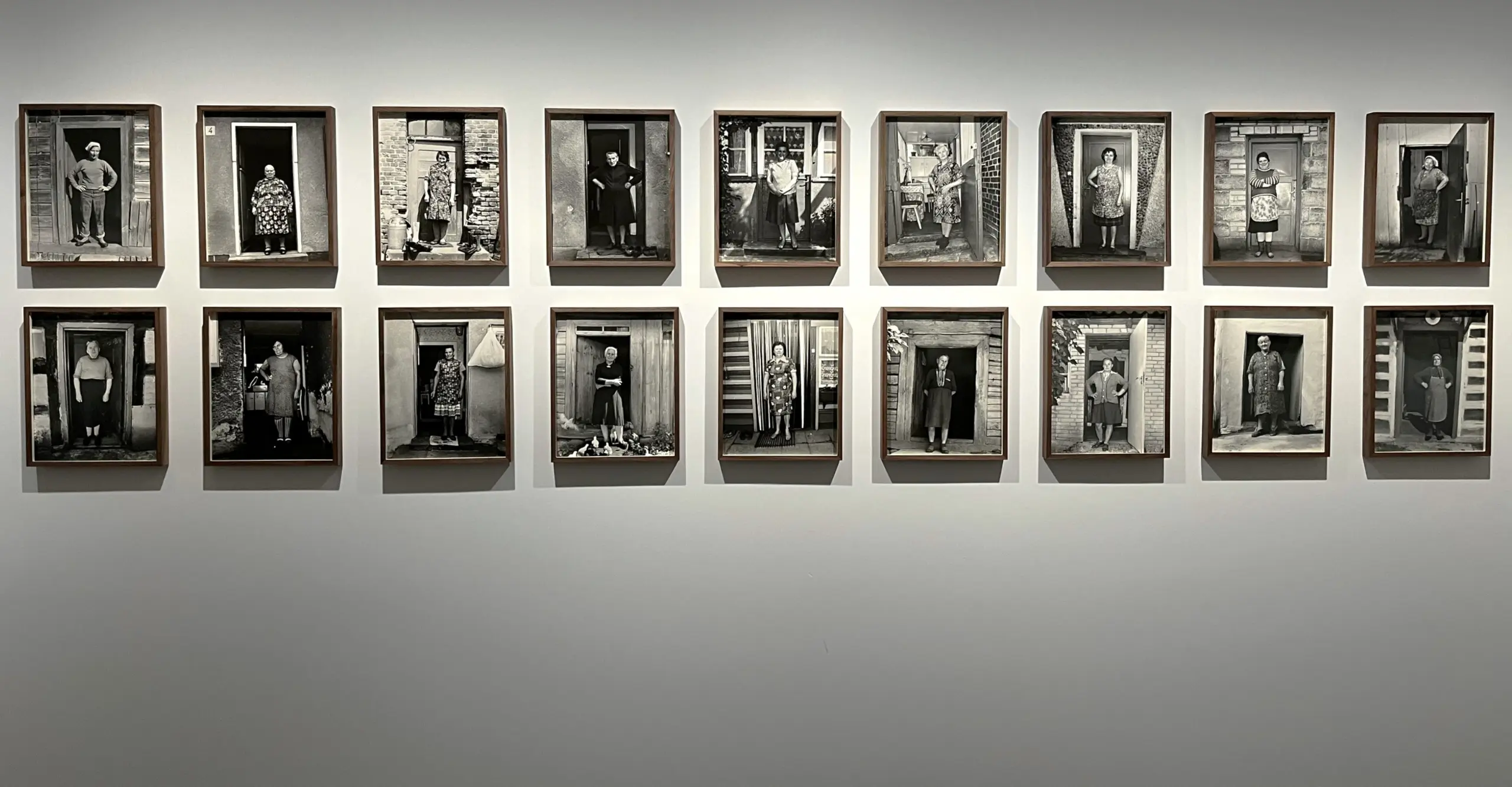
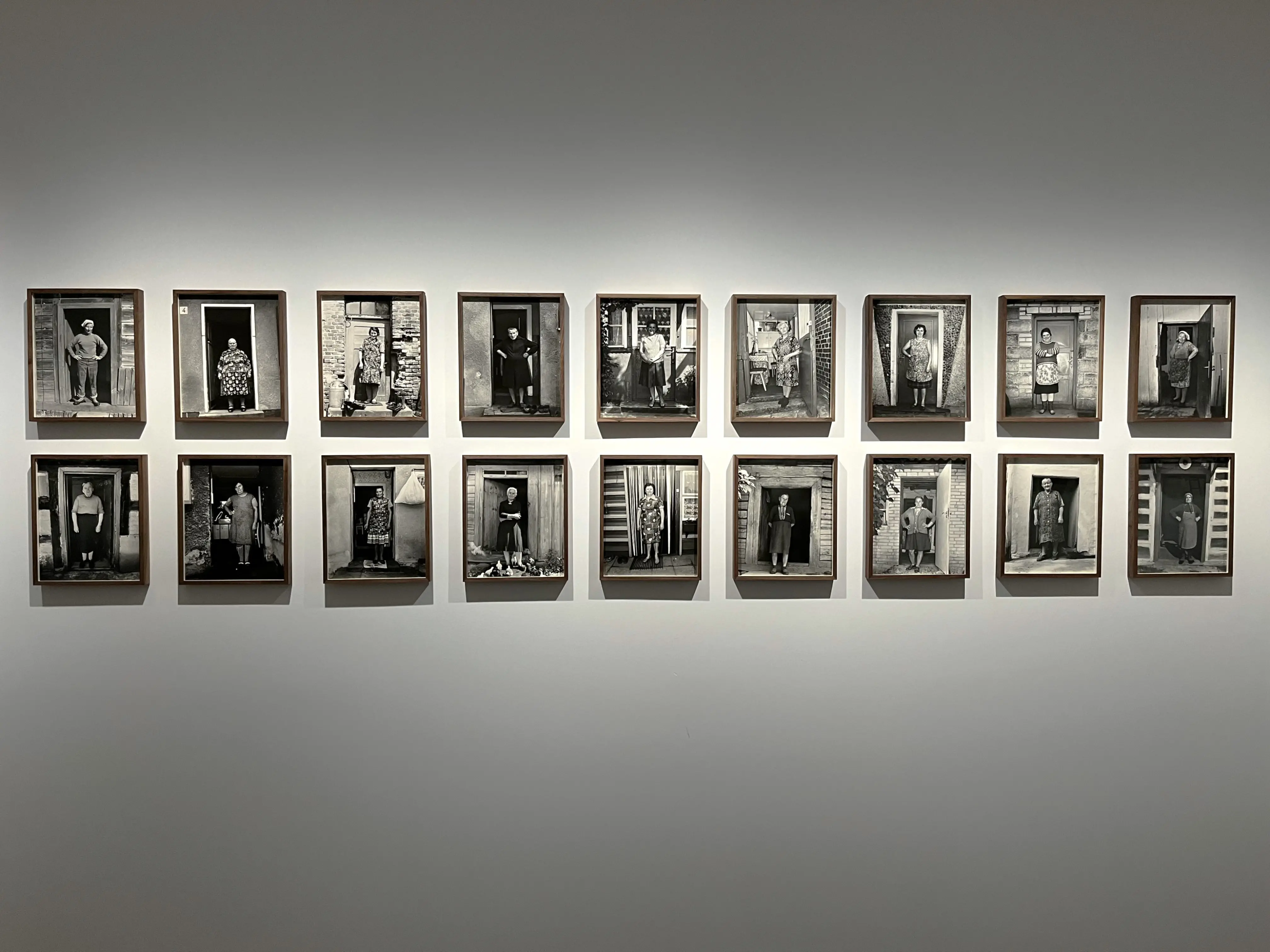
This group of 18 black and white photographs is displayed in two rows, each holding nine photographs in portrait format, all with identical dark wooden frames.
Each photograph is of a woman standing in the doorway of her home, some in the region of Podhale, in the foothills of the Tatras, and some in the more urban areas of Silesia. Zofia Rydet said of this series: ‘you can tell where the pictures were taken: if the woman is taller than the doorway to her cottage you know at once it’s Podhale, while if the door frame is far above the woman’s head, it’s Silesia.’ The repetition of the motif allows for similarities and differences to emerge. One woman stands in front of a low, almost square, doorway framed by heavy wooden logs – evidently a mountain cottage - she would need to duck her head and step over a raised threshold to enter. Others – in the more urban areas of Silesia - have twentieth-century front doors that open towards us, giving a glimpse of the kitchens beyond the women. Five of the women stand with both hands on their hips – they include women of different generations and experiences, such as a middle-aged woman wearing trousers and a headscarf, and an older woman in a severe black dress. Three wear aprons, and four wear vibrantly patterned tabards to protect the clothes during housework. There is a sense of the love of pattern that also emerges in Rydet’s documentation of interiors: many of the garments are heavily patterned, and sometimes the interlocking logs that make up the walls of the cottages have been painted with stripes. Women’s work is glimpsed at the edges of the photographs, whether in the rural or urban settings: a milk churn and several pairs of shoes and boots stand on one threshold; one woman has chickens at her feet while another has a hanging curtain of plastic strips over the doorway - presumably multicoloured - to keep flies out of the house.
Transcript - Silesia 1978-1990
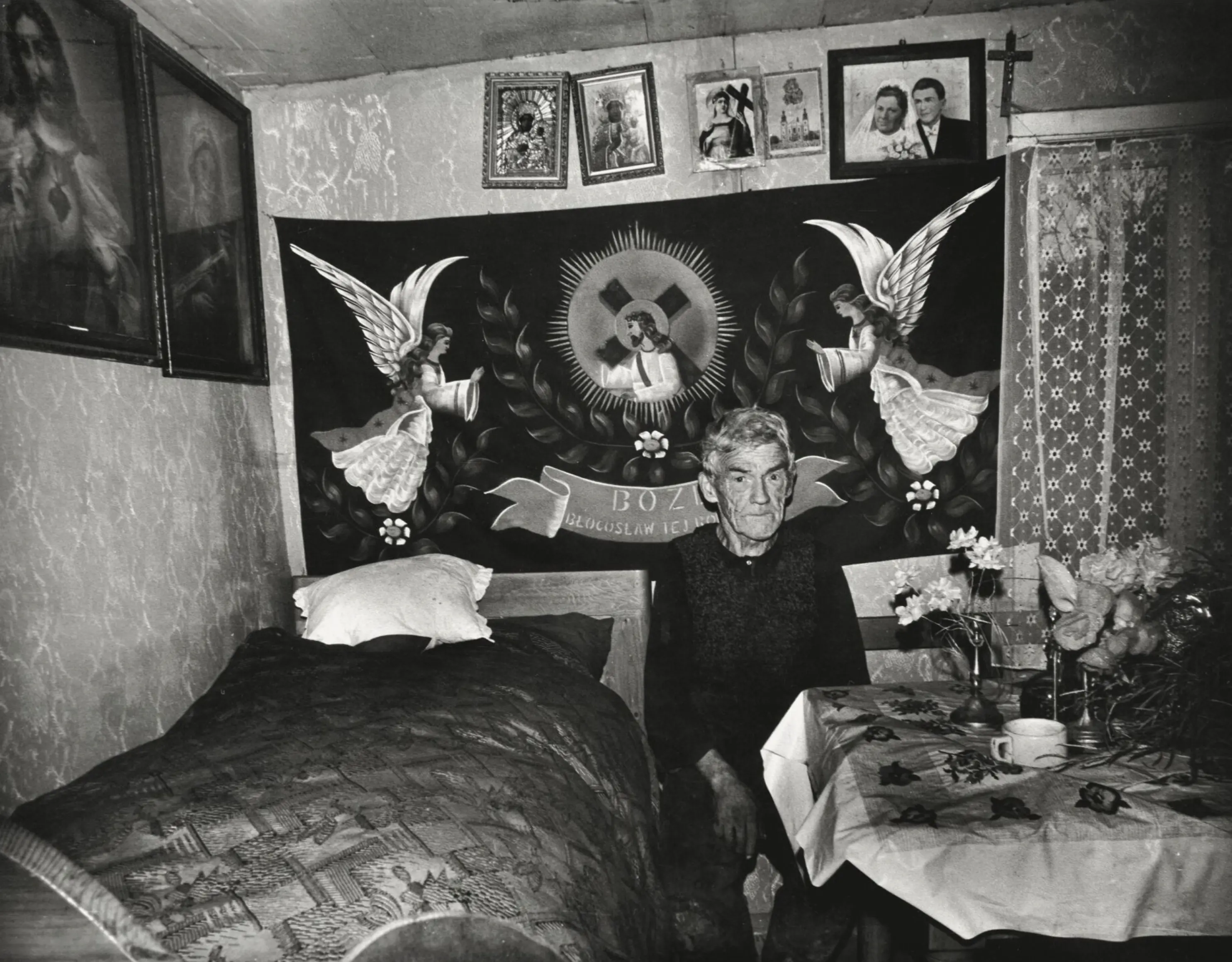
In this black and white photograph, a man in his sixties or seventies sits facing us, just a few metres from the photographer, giving the sense that we are in a small room.
The man has a creased face with thick, unruly hair that appears to be silvered while his eyebrows are dark. He has a watchful, even wary, expression. He wears dark clothes that are hard to make out – a black shirt under a black woollen vest and dark trousers that seem worn at the knee.
The low-ceilinged room contains a single bed and a small table, with just enough space for someone to slip between them. The man sits on the other side of the table, tucked into the room and surrounded by his possessions. The table, on the right-hand side of the photograph, is covered with a plastic tablecloth printed with a floral design, and slightly rucked up. On it stand a couple of bunches of artificial flowers in vases, along with a white coffee cup. Behind the table, one corner of a window is visible, covered with a net curtain decorated with a geometric daisy pattern.
The wooden bed has a white pillow and a slightly shiny brocade bedspread. The walls of the room are covered with a similar brocade pattern wallpaper. On the left- hand wall, hanging just under the wooden ceiling, there are two framed and glazed paintings, one of Jesus displaying the sacred heart, and another of a female figure, probably Mary. On the back wall, behind the bed, and reaching right across to the window, there is a textile hanging, about three metres wide, in folk art style, showing Jesus lifting the cross on his shoulder, flanked by two angels with flowing hair, large wings and long white dresses. Wreaths curl around all three and in the centre, words on a scroll read Boże błogosław tej rodzinie… meaning, God bless your family… The man’s face is framed by the scroll, seeming almost to become part of the wall hanging. Above it, there are five framed images – two versions of the Black Madonna of Czestochowa, a saint holding the cross, a drawing of a large church with two towers, and a wedding photograph.
Transcript - Lower Silesia, 1978-1990
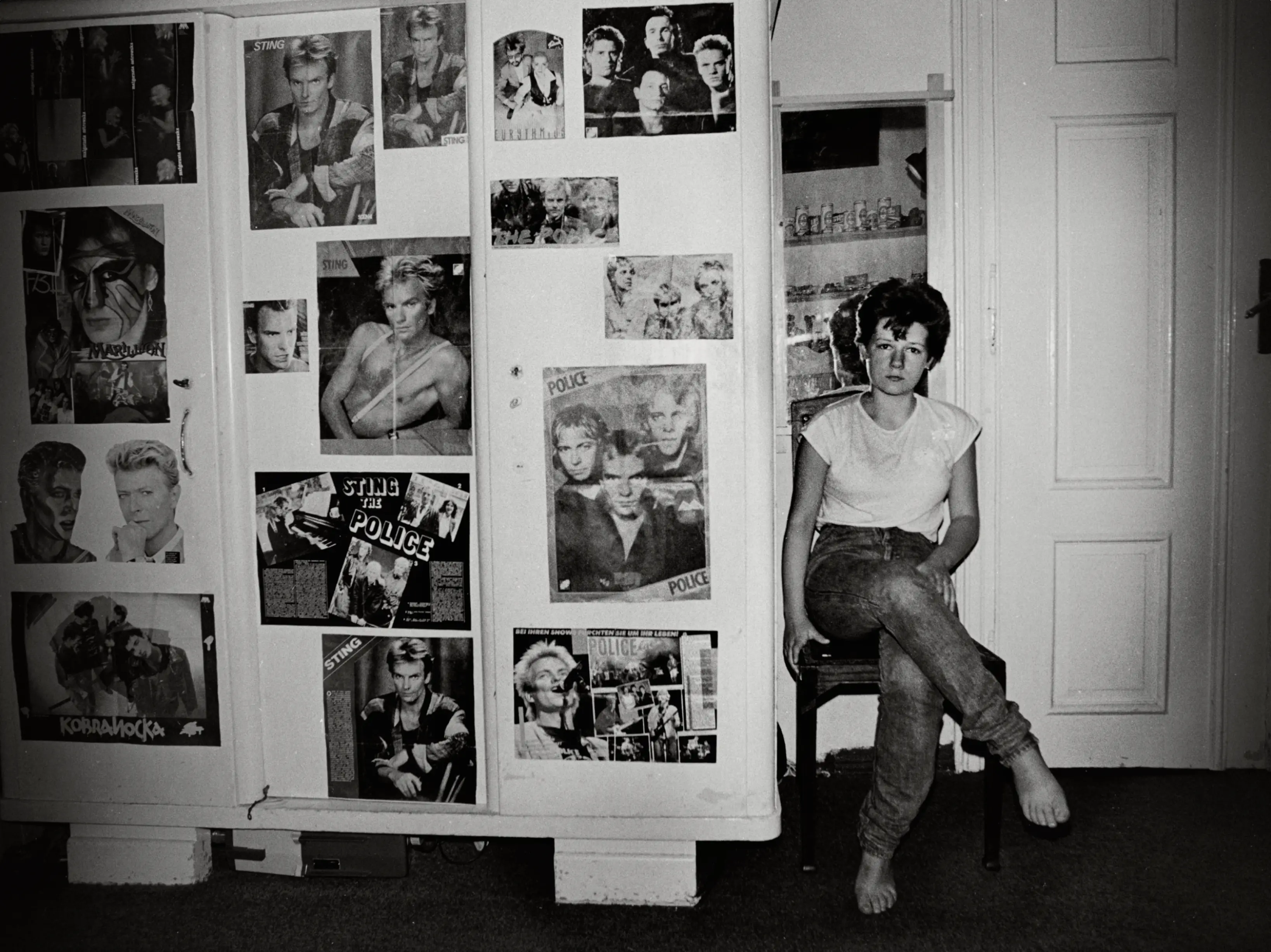
In this black and white photograph, a young woman sits facing us in what is presumably her bedroom. The furniture in the room seems to divide the image into five vertical strips. On the left, there is a triple wardrobe in white painted wood, decorated with pages from magazines showing pop stars. Most of the images are of Sting and the Police. Pride of place is given to a portrait of Sting reclining on one elbow, wearing braces over his bare chest, a centrefold from the Polish pop magazine Razem. Another photo of Sting, wearing what appears to be a multicoloured jacket, is reproduced three times at different sizes. Images of British prog-rock band Marillion and the Polish rock band Kobranocka appear on the left-hand door of the wardrobe, along with a pair of three-quarter profile photos of David Bowie that have been cut out and pasted to the door, face to face.
Sitting to the right of the wardrobe, the young woman appears to be in her mid-teens, with dark hair cut in a shaggy crop with a fringe. She wears a white short-sleeved t-shirt and jeans, with her feet bare. She sits with her legs crossed, meeting the photographer’s gaze, although her right hand holds onto the seat of the wooden chair, as if for reassurance. The narrow mirror behind her shows the reflection of shelves on the opposite wall – the top shelf appears to hold cans of beer. The reflection of the flash in the mirror produces a double image and makes the young woman appear slightly flattened, as if she’s also been cut out of a magazine.
Finally, the right hand side of the photograph contains a tall panelled door, painted white, one half of a pair, suggesting that we are in a nineteenth-century apartment in a city.
Transcript - The Myth of Photography
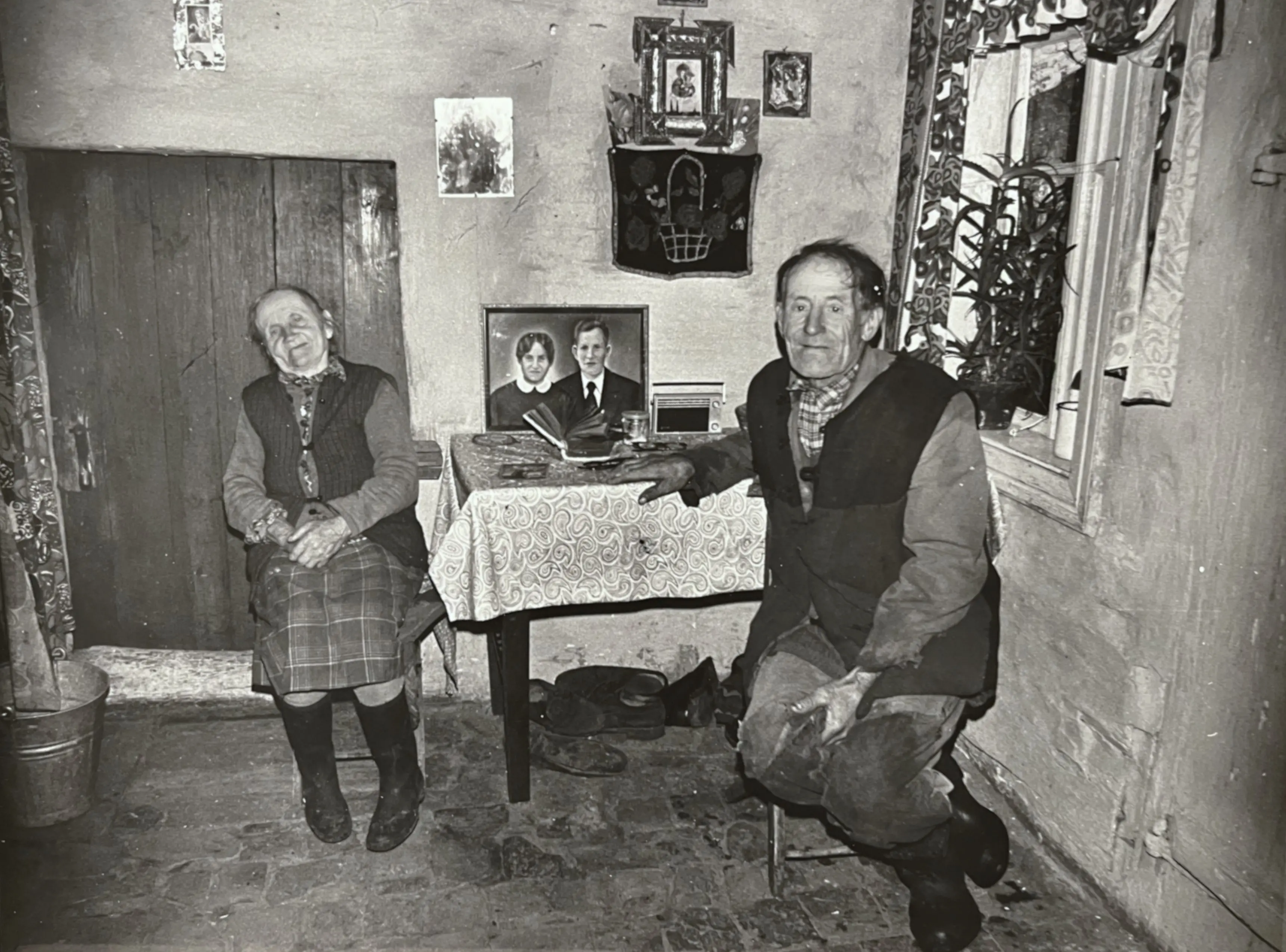
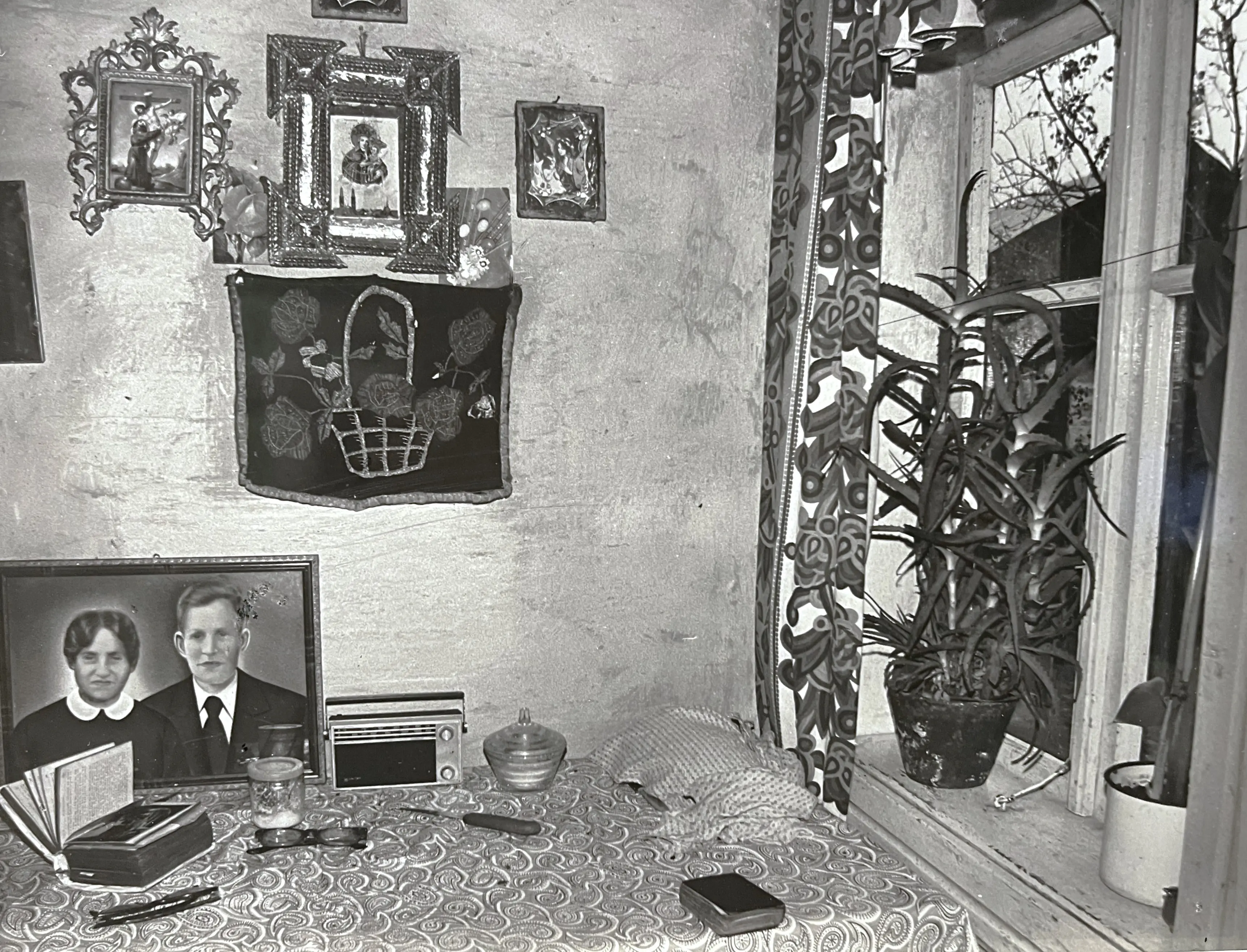
This pair of photographs presents first a room with its inhabitants, and then a close up of a corner of the same room, focusing on the objects without people.
In the first photograph, an elderly couple sit facing us in the corner of a cottage room. The floor is of stone cobbles and the walls are roughly plastered. Directly opposite us is a square door of rough wooden planks, about a metre and a half high. A woman sits on a chair in front of the door, wrapped up in warm layers – a cardigan over a print blouse, with a thick woollen jerkin on top, a plaid skirt and knee-high boots. Her hands are folded in her lap, and her head is thrown back, as if she is resting it on the door, and tilted slightly to the left. Combined with her smile, this gives her a soft, amused expression.
A small table with a paisley patterned oilcloth is pushed into the corner of the room to the right. In front of the table, a man sits facing us. He’s resting one elbow back on the table and leaning forward, his legs crossed at the ankle beneath him, his other hand pressed between his knees. He is similarly wrapped up in checked shirt, sweater and jacket, with a heavy jerkin on top. His jacket and trousers are both frayed, patched and heavily stained. He has a deeply creased face, his cheeks lifted in a slightly tense smile.
Resting on the table between the two people, propped against the wall, is a wedding portrait. It shows a young woman with dark wavy hair, wearing a dark dress with a round white collar, and a young man wearing a suit with a dark tie. The deep-set eyes and warm smile of the woman and the prominent ears and long face of the man resemble the older couple and suggest this is a portrait of them in their youth. Rydet was very interested in the significance of family photographs in sparsely decorated rural cottages, particularly the hand-coloured wedding portraits known as monidła. They emerged in the nineteenth-century as a cheaper alternative to oil portraits, and were based on black and white photographs: lips were tinted red and eyes sky blue, while outfits were sometimes retouched to make them more elaborate.
On the wall above the table, there are several small, framed pictures, including an image of the Black Madonna of Czestochowa in a fancy metal frame, and beneath it, a hand-made textile collage of flowers in a basket.
In the second photograph, the couple is absent and the focus is tighter, a still life study of the objects on and around the table. The right-hand wall holds a small window with a deep recess containing a pot plant and framed by curtains with a bold floral pattern in 1960s or 70s style. The chunky hinges of another wooden door are just visible at the right-hand edge of the frame. On the table in front of the wedding portrait, there is an open Bible and two pairs of reading glasses. To the right of the portrait there is a small transistor radio and a glass sugar pot. Another small black book, presumably a Bible, is on the edge of the table, near where the man sat.