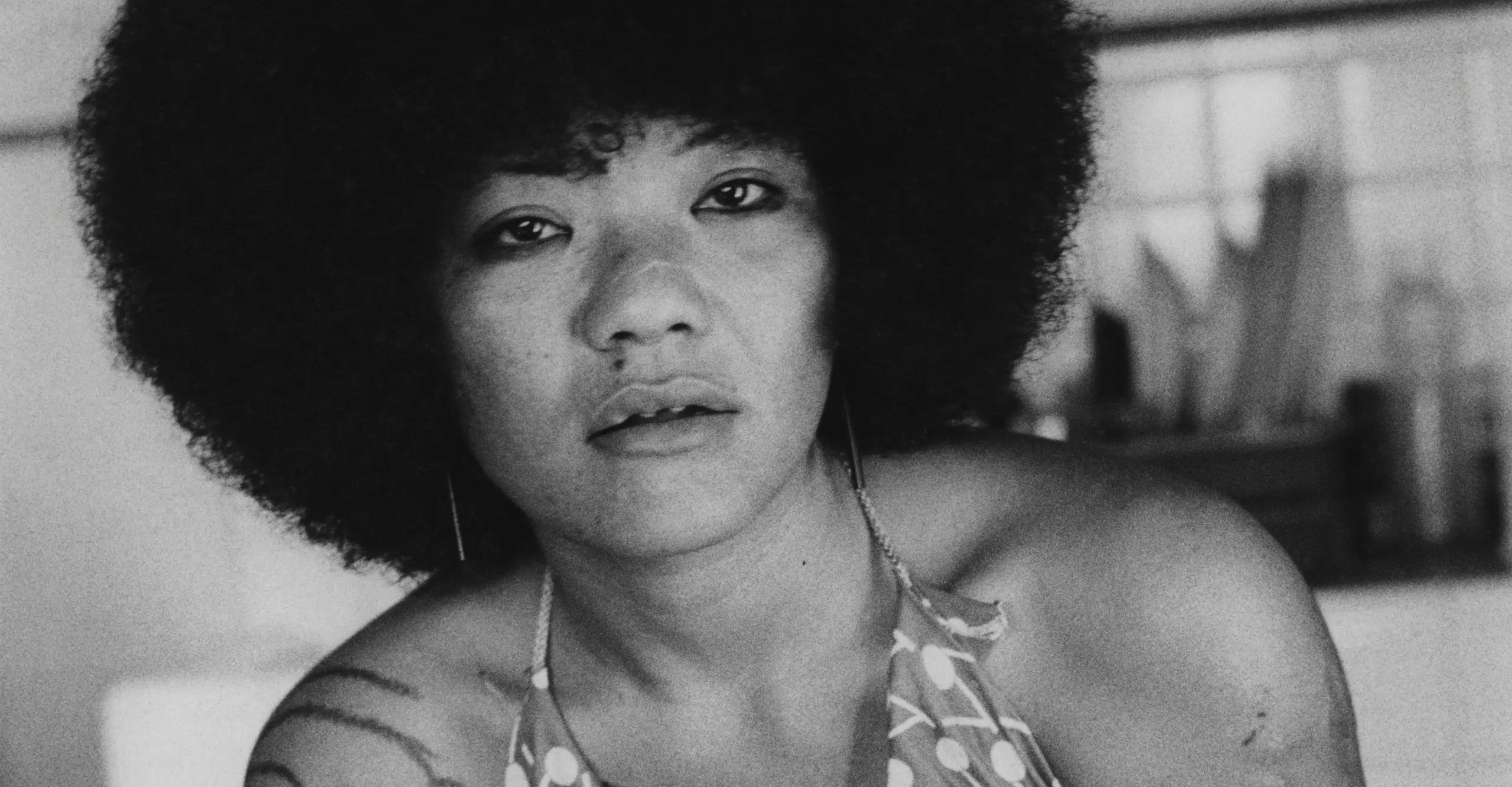
常盤 とよ子 TOKIWA Toyoko
“When I think about it, I was told, ‘I don’t know many women like you who go wherever they want to go and sneak around and take pictures.’ I think that was a compliment.”
Full bio
TOKIWA Toyoko (1930–2019) grew up near the US military base of Yokohama, and after joining the women-only Shirayuri Kamera Kurabu (Shirayuri Camera Club) in 1951, began documenting the consequences of the postwar US occupation, focusing on Japanese women sex workers and other marginalised communities.
She developed an ethically engaged practice centred on women as subjects with agency, becoming best known for her long-term engagement with women working in nightlife districts, whom she approached with dignity and complexity. In 1957, she participated in the historic exhibition Jūnin no me (Eyes of Ten) at the Konishiroku Gallery in Tokyo alongside photographers including NARAHARA Ikko and TOMATSU Shōmei, among others who formed the core of the Vivo photography collective.
渡 辺 眸 WATANABE Hitomi
“Outside the barricade, there were usually only one or two reporters from the media. As a photographer aligned with Zenkyōtō, it gave me access to places media reporters were never allowed to go to.”
Full bio
WATANABE Hitomi (b. 1943) graduated from Meiji University and, after enrolling as the only woman at the Tokyo College of Photography in 1967, began taking photographs in the streets of Shinjuku, a centre of 1960s counterculture and resistance to the US military presence in Japan and the Vietnam War.
Between 1968 and 1969, she photographed protestors occupying the University of Tokyo’s campus and followed the Zengaku Kyōtō Kaigi (Zenkyōtō), documenting the longest and most violent Japanese student uprising of the era from within the movement. One of the very few women photographers covering these events, she is now recognised as an invaluable contributor to Japan’s photographic history.
山沢 栄子 YAMAZAWA Eiko
“There can be no liberation of women while they are hired by men and always work in worse conditions than men.”
Full bio
YAMAZAWA Eiko (1899-1995) studied nihonga, a style of Japanese painting, at Joshibi School of Art and Design, Tokyo, graduating in 1918, and in 1926 left Japan to study at the California School of Fine Arts, leading to part-time work as an apprentice to portrait photographer Consuelo Kanaga and later work retouching prints for photographer Nickolas Muray in New York.
In 1931, YAMAZAWA became the first woman to open a photography studio in Osaka, and in 1950 established the Eiko Yamazawa Photography Research Institute to “educate the next generation,” prioritising support and hiring women. She later began experimenting with abstraction and vibrant primary colours, and her photobook Enkin (Far and Near) (1962) brought together seventy-seven photographs made between 1943 and 1962, tracing her transition from commercial portraiture to an increasingly experimental practice and her legacy of a singular artistic style.
岡上 淑子 OKANOUE Toshiko
“The ingredients are glue, a pair of scissors and your fingertips."
Full bio
OKANOUE Toshiko (b. 1928) graduated from the Ogawa Fashion Institute in 1949 and continued in the design department of Bunka Gakuin University, Tokyo, graduating in 1952. During her brief career, spanning from the early to the late 1950s, she created an extraordinary array of surrealist avant-garde collages, influenced by Max Ernst, crafted by cutting out material from magazines such as Time, Life, or Vogue, a pragmatic choice shaped by postwar scarcity and the US occupation. Her collages, filled with young girls, fashion, architecture, and décor, was little known for decades until her rediscovery in the 1990s, and is now recognised for its inventive intersection of photography and surrealism in postwar Japan and its engagement with media, desire, gender, and the visual aftermath of war.
西村 多美子 NISHIMURA Tamiko
“I wanted to capture what lies beyond the point where what is seen and what is unseen become one. I wanted to give form to what spills out from beyond the point of taking a picture.”
Full bio
NISHIMURA Tamiko (b. 1948) graduated from Tokyo College of Photography in 1969 with a project documenting the underground theatre performances of the Jōkyō Gekijo troupe and soon after met MORIYAMA Daidō, TAK Kōji, and NAKAHIRA Takuma, members of the avant-garde Provoke group, briefly working in their office and assisting them in the darkroom.
Photographing in an instinctive, spontaneous style, her work is often both performative and personal, including the early series Neko ga... (Kittenish...) first published in Camera Mainichi magazine in 1970, a notable example of shishashin or “I-photography,” a form of photography rooted in personal narratives. Her first photobook Shikishima (1973) featured intimate portraits that blur the line between self and other, establishing her as a compelling voice in Japanese photography, and she described her career as “a sequence of journeys, continually photographing her nomadic existence.”
川内 倫子 KAWAUCHI Rinko
“Part of why I make photographs is to confirm my existence. That liminal space is what feels closest to how I experience reality.”
Full bio
KAWAUCHI Rinko (b.1972) studied graphic design and photography at Seian University of Art and Design, Kyoto, and after graduation worked as a freelance photographer while also working for commercial photography studios in Tokyo and Osaka. In 2001, she made her debut with the simultaneous release of three photobooks, Utatane, Hanabi, and Hanako, and went on to publish over twenty-five books.
Her work is characterised by a delicate, dreamlike visual universe and a unique use of colour, photographing everyday life with near-meditative attentiveness and focusing on small gestures, overlooked phenomena, and ephemeral experiences to create a “photographic poetics” of quiet presence and emotional resonance. Deeply rooted in spirituality and ritual, she works at a slow pace with a medium format camera, producing contemplative sequences that suggest cycles, seasons and the rhythms of existence.
潮 田 登久子 USHIODA Tokuko
“I have always worked as a record keeper. It’s very interesting to see how the world changes through the camera.”
Full bio
USHIODA Tokuko (b. 1940) graduated from Kuwasawa Design School, Tokyo, in 1963, went on to become a teacher at that same school and later at Tokyo Zokei University, and throughout her career worked as a serial memorialist, recording her own daily life with a focus on meaningful places and objects she did not want to forget, including an old refrigerator given to her after the birth of her daughter, Maho. She began photographing domestic objects in order to document her life.
In the early 1980s, she also became interested in other people’s refrigerators, photographing them both open and closed as reflections of private lives, a series later published as Reizōko (Ice Box) in 1996, showcasing 57 refrigerators with data on households’ location, composition, and occupation. While raising her daughter she continued to work for magazines to support her artistic work, becoming a significant figure in postwar Japanese photography whose work centers on everyday life, gendered experience, and the politics of domestic space.
石内 都 ISHIUCHI Miyako
“I am interested in the shadows rather than places in full light, the muddy rather than limpid stream, minor motives rather than major. I believe that time flows beautifully in such things.”
Full bio
ISHIUCHI Miyako (b. 1947) interrupted her design and textile studies at Tama Art University, Tokyo, in the mid-1970s to devote herself to photography and began her career in Yokosuka, her hometown and the site of a major US military base after World War II, while also being involved in uman ribu, Japan’s 1960s women’s liberation movement. Her photographs blended personal and political perspectives as she documented the presence and traces of the occupation, published in three volumes: Apartment (1978), Yokosuka Story (1979), and Endless Night (1981), including work in red-light districts, US Navy bases, and an old brothel in Yokohama frequented by American military personnel.
Throughout her career, she focused on recording the material traces of the passage of time, later turning her lens toward the bodies and experiences of women entering their forties and questioning the notion of an expiration date for women’s beauty. In her series Mother’s (2000–2005), she created “portraits” of her mother’s possessions to explore womanhood, motherhood, and maternity, and the series was selected to represent Japan at the 2005 Venice Biennale, establishing her international recognition.
野口 里佳 NOGUCHI Rika
“Our daily lives are filled with small miracles that we don’t notice. Those are the things I want, somehow, to photograph"
Ge to know NOGUCHI Rika
NOGUCHI Rika (b. 1971) graduated from the Department of Photography at the Nihon University College of Art, Tokyo, in 1994. Critical recognition of her work noted in it the development of a new photographic language. She adopted a conceptual, artistic vision in luminescent colours that is simultaneously straight and abstract, poetic and ethereal. Over the past thirty years, NOGUCHI has explored natural phenomena and the mysteries of perception. As writer YOSHIMOTO Banana remarks: “In her photographs, one senses the aroma of physics, of geology, of astronomy.”
Her work moves between the microcosmic and the macrocosmic. It invites viewers to reconsider perception, scale, and our place within the visible world. NOGUCHI has developed a practice rooted in a sense of wonder and the enigmatic qualities of light, space, and life. In 2007, critic MATSUI Midori included NOGUCHI as part of a movement she named “Micropop” - a term that referred to a group of artists born in the late 1960s and ’70s, such as NARA Yoshitomo and OCHIAI Tam. Together, they were considered to have developed “a new aesthetic consciousness... through the combination of fragments of information gleaned through one’s own experience.” For NOGUCHI, photography has always been an art and a means of redefining image and life as one.
米田 知子 YONEDA Tomoko
“To me, bombers connect to my parents’ childhood memories of air raids and my own childhood memories of hearing those stories. Japanese skies turned dark by B-29 aircraft day after day. In 2003, while I was in the UK, I went to see one of those aircraft with my own eyes.”
Get to know YONEDA Tomoko
YONEDA Tomoko (b. 1965) makes work that explores the fragile boundaries between memory, history, and the photographic image. Living between Japan and the United Kingdom, she produces images that return to sites marked by political and historical events. She often photographs locations where meaning emerges indirectly, grounded in archival research and fieldwork. The work suggests rather than explicitly depicts her subject matter.
YONEDA’s transnational experience informs a position between documentary observation and conceptual inquiry. Working primarily with analogue large-format photography, she employs a restrained visual language that emphasises atmosphere, absence, obscurity, and fragmented memory.
野村 佐紀子 NOMURA Sakiko
“I aim to connect small fluctuations, big sorrow, life and death, everything that you love that surrounds you.”
Get to know NOMURA Sakiko
NOMURA Sakiko (b. 1967) developed an interest in photography when she was eighteen. She started shooting nudes during her college years at Kyushu Sangyo University, and, shortly after graduating in 1991, became an apprentice of ARAKI Nobuyoshi. She is best known for her intimate portraits, particularly of men, and for her juxtapositions of sensual scenes with cityscapes, seascapes, and still lifes.
NOMURA works in black and white and in colour, using various formats, including Polaroids that she presents as a series. Each frame offers a mini-fiction. Her practice is characterised by a haunting use of black‑and‑white imagery, deep shadows,
楢橋 朝子 NARAHASHI Asako
“I have always had a hard time with questions like ‘What is your theme?’ or ‘What are you photographing?’ I don’t think it would have been acceptable to bluntly say, ‘I take photographs’, but I feel that, especially at that time, I was doing something that could only be described as ‘photography’.”
Get to know NARAHASHI Asako
NARAHASHI Asako (b. 1959) graduated as an art major from the School of Literature II at Waseda University, Tokyo, in 1989. As a college student in the mid-1980s, she was deeply inspired by MORIYAMA Daidō and participated in a workshop he led in 1986. Her earliest work consisted of “photo-diaries,” made up of thousands of small prints, and in 1990 she opened her own gallery, 03FOTOS, to present her work and that of fellow artists. Six years later, she and ISHIUCHI Miyako co-founded the self-published magazine main.
In the early 2000s, NARAHASHI turned to colour photography, becoming interested in photographing while immersed in the sea and other bodies of water. Her images communicate both an adoration and a fear of nature, creating an intimate yet disorienting perspective that challenges conventional notions of horizon, scale, and orientation. Employing soft focus, low saturation, and minimal compositions, her photographs evoke mood, memory, and the passage of time. Made several years before the 2011 Tōhoku earthquake and tsunami, they also convey a striking sense of humankind’s vulnerability to elemental forces.
原 美樹子 HARA Mikiko
“By not sticking to the viewfinder, the boundary between what is in and out of the viewfinder becomes ambiguous. In a way, I don’t know what range I looked at and what range my camera looked at. I do not set a theme in advance, nor do I try to convey my own message through my photographs....in this or that way, I would like to keep myself in a state of openness to the external world around me.”
Get to know HARA Mikiko
HARA Mikiko (b. 1967) graduated from the Faculty of Literature at Keio University, Tokyo, in 1990. She initially worked as an actress in underground theatre groups before becoming a photographer through a series of coincidences: finding her father’s camera, receiving an enlarger from a friend, and learning to print from a photographer. In 1992, she began studying photography at Tokyo College of Photography, first working in black and white, then turning to colour before graduating in 1996.
Since the mid-1990s, she has been using a medium-format German camera—an Ikonta from the 1930s. This old camera, combined with a 1950s lens and Kodak colour film, allowed her to develop her own style, characterised by an unusually delicate, pale palette. Aiming in the general direction of the gestures or details that attract her, she often releases the shutter spontaneously, without pausing to look through the viewfinder. The resulting images—dreamy, slightly out of focus, and off-centre—compose what she describes as “an accumulation of fragments of my daily life.” She regards her snapshots as conduits, hoping they will resonate with fragments of other people’s memories.
石川 真生 ISHIKAWA Mao
“I did not intend to take ‘sneak-peek photos’ on the sidelines. I am neither a magazine photographer nor a photojournalist. I started taking photos by involving myself in the situation. It is not only a documentary but also my own emotional record.”
Get to know ISHIKAWA Mao
ISHIKAWA Mao (b. 1953) has spent more than forty years documenting the people, politics and social issues of her native Okinawa, particularly the ongoing debate over the US military presence and the legacy of Japan’s colonisation of the islands. After studying briefly under TŌMATSU Shōmei in the early 1970s, she returned to Okinawa and, between 1975 and 1977, worked as a barmaid in establishments serving African American GIs stationed near Camp Hansen, photographing the soldiers’ relationships, nightlife and daily lives. These images formed her first book, Atsuki hibi in Kyanpu Hansen!! (Hot Days in Camp Hansen!!) (1982).
Since then, she has continued to document the US military presence, including violence against women, environmental damage and local responses to these issues. Working from within the communities she photographs, her raw and intimate images foreground the complexities of human relationships, exposing how history and geopolitics are lived through intimacy, power, agency and survival.
ヒロミックス HIROMIX
“I see potential for the selfie to serve as a powerful tool for raising self-esteem, helping anyone to achieve a profound acceptance of self, to love oneself, and accept the way each of us are made by nature. I think that there are, in fact, a fair number of people who, when making a selfie, experience an enlightened state of mind.”
Get to know HIROMIX
HIROMIX rose to prominence in the mid- to late 1990s through self-portraits and images of her life as a high-school student. Her first photobook, I’m Hiromix: Girls Blue (1996), achieved record sales in Japan, and she quickly became a prominent cultural figure, working for major fashion brands, publishing extensively, appearing in an Yves Saint Laurent commercial, posing for Wolfgang Tillmans, and playing herself in Sofia Coppola's Lost in Translation (2003).
Using the Konica Big Mini camera, she helped inspire the “Big Mini Revolution”, while her work became closely associated with onnanoko shashin (“girls’ photography”), often grouped under the label “Girly Photo”. Although she described the movement as a new and expressive form of photography, the term also reduced the work of many young women artists to something merely “cute” or amateurish. Catapulted to international fame at a young age, HIROMIX later struggled with the exploitation and abuse she experienced during her rapid rise to prominence.
澤田 知子 SAWADA Tomoko
“I am interested in the relationship between what is seen on the outside and what is inside (...) but it is important to understand that these images are not an expression of myself personally but an exploration of the way we classify people —typologies.”
Get to know SAWADA Tomoko
SAWADA Tomoko (b. 1977) photography at Aalto in Helsinki and began working with black-and-white self-portraiture in 1995, using photography as a tool for conceptual inquiry into subjectivity, normativity and representation. She first came to prominence with ID400 (1998), created in a photobooth in Kobe, in which she transformed herself into four hundred distinct characters, emphasising identity as something produced through external codes rather than internal essence.
Her work consists largely of serial self-portraits that combine typological conceptualism and role-play, using make-up, costume and performance to interrogate conformity, feminine beauty and gender roles. Through playful yet highly constructed images in which she appears as both individual and group, SAWADA explores questions of selfhood, womanhood, social status and identity, while exposing the persistence of racialised stereotypes.
長 島 有里枝 NAGASHIMA Yurie
“The self-portrait means that you can take on both roles, as a model and as a photographer. It’s very symbolic. It’s a way of taking action against the historical roles of the male and female in photography.”
Get to know NAGASHIMA Yurie
NAGASHIMA Yurie (b. 1973) rose to fame with a series of everyday scenes of herself and her family at home nude. The work was intended to confront and parody the soft-core porn images that were trending in Japanese mainstream media. NAGASHIMA has consistently documented her life through photography, capturing her student years, pregnancy, and motherhood. Additionally, she has published novels and essays, and worked collaboratively, performatively, and as a curator. Throughout she has continued to develop her radical artistic language with a particular interest in gender and social-class issues in Japanese society and the Japanese photography world.
Today, NAGASHIMA is considered one of Japan’s most critically minded contemporary artists and an ardent activist who questions and pushes boundaries while advocating for deeper thinking, understanding, and inclusion.
やなぎみわ YANAGI Miwa
“Suddenly I saw these women, who were continuously performing their role before the audience that is the society at large. I became interested in women who had to act like robots reciting their given words and actions over and over in a ritual-like way, and I decided to do a work based on this image.”
Get to know YANAGI Miwa
YANAGI Miwa (b. 1967) began integrating photography and performance into her practice in 1991, drawing on the influence of the Takarazuka Revue, the all-women musical theatre troupe she attended regularly as a child with her mother and grandmother.
After shifting from fibre installation to photography in the early 1990s, she explored the standardisation and anonymity of women’s roles in consumer-oriented urban Japan. Shortly after graduating, she presented The White Casket, a tableau vivant featuring women performing as department-store “elevator girls”, figures that became central to her examination of gender and social conformity. Through carefully staged scenes set in elevators, mirrored rooms and confined interiors, YANAGI combines photography, psychology and theatre to create unsettling spaces that evoke suffocation, isolation and personal exploration.
岡部 桃 OKABE Momo
“As my photography is based on shishōsetsu, the Japanese I-novel, it is always made up out of my own, actual experiences... And while I work from my private life, I hope it positively resonates within people as part of their lives, too.”
Get to know OKABE Momo
OKABE Momo (b. 1981) emerged in the 2000s with a body of work that blends tenderness with raw intensity, often using colour expressively, and explores issues of gender, sexuality and identity related to herself as well as her lovers and friends, whom she describes as “the outsiders of Japanese society”. In high school, she joined the photography club and began taking photos of friends, family, her room, home and neighbourhood, and in 1999 began photographing her lover and his friends.
Her first book, Dildo (2013), is a radical body of work featuring Kaori and Yoko, Okabe’s lovers, both of whom were transitioning at the time, combining images of their lives with documentation of their gender-affirming surgery, materials that were and remain extremely rare in Japan. Her hyper-saturated, raw and personal photographs serve her subjects and community, speaking to anyone moved by or identifying with their experiences.
蜷川 実花 NINAGAWA Mika
“I was furious about the inequality between men and women, about the idea that you couldn’t do certain things or had to put up with being told certain things because you were a woman.”
Get to know NINAGAWA Mika
NINAGAWA Mika (b. 1972) is a renowned image-maker working in film, fashion and music who began using a simple point-and-shoot camera at an early age, influenced by her upbringing as the daughter of an actor mother and a critically acclaimed theatre-director father.
Her distinctive style, first recognised in the 1990s, is characterised by a bold, hyper-saturated use of colour, often incorporating flora and fauna such as wildflowers and goldfish, as well as unconventional angles and close-up perspectives. Her work is immediately recognisable for fluorescent pinks, deep reds and electric blues, with dynamic compositions that amplify sensuality and movement. She explores themes of desire, mortality and the fleeting nature of beauty, frequently using flowers as metaphors of ephemerality in line with the Japanese concept of mono no aware. Alongside her photography, she has also built a successful career as a film director.
オノデラユキ ONODERA Yuki
“Recognising that you’re in an unstable, suspended state and looking at the world from that perspective, everything becomes visible. You’re forced to become a foreigner, who doesn’t belong to anything. You need to understand that even the earth you’re standing on is just a fiction.”
Get to know ONODERA Yuki
ONODERA Yuki (b. 1962) graduated from Kuwasawa Design School, Tokyo, in 1984, worked briefly as a fashion designer, and began using her father’s camera before deciding to become a photographer. She moved to Paris in 1992, where she established her own studio and continues to live and work today, and throughout her work observes the body in space and in motion while continuing to experiment with the medium in playful ways.
Her practice celebrates photographs as objects with endless possibilities, not only through the image but through engagement with photographic materials, manipulation in the darkroom and digitally, and experimentation with scale and movement. The series on display captures people’s unconscious movements and gestures without looking through the viewfinder, with subjects’ faces obscured by lace-like perforated paper applied through the photogram process, representing a rigorous and poetic investigation into the potentials of the materiality of the photograph.
杉浦 邦恵 SUGIURA Kunié
“Through chances and failures, I believe you can find a critical new perspective, a new critical mind. Whether you admit or reject it, the chance of failure significantly affects your art.”
Gwt to know SUGIURA Kunié
SUGIURA Kunié (b. 1942) moved to the United States in 1963 to study at the School of the Art Institute of Chicago after initially studying physics in Tokyo. Over the past six decades, she has worked like a photographic scientist, conducting experiments with the medium, and describes herself as a “double outsider” (though truly a “double insider”) who brings together Japanese and Western influences. After moving to New York in 1967, she developed series of close-range photographs of nature—flowers, beaches and trees—taken with a single-lens reflex camera and enlarged and printed on canvas.
After briefly experimenting with painting, she created Photo-Painting (1975–81), presenting black-and-white stills printed in monochrome on canvas that evoke Film Noir and New Wave cinema. In the 1980s, she began working with photograms and treating photographs as objects that can be folded, layered, mounted or physically altered. This material approach aligns her practice with Post-Minimalist concerns, while maintaining a strong emphasis on sensuality and visual pleasure.
小松 浩子 KOMATSU Hiroko
“Text and photographs are very similar. A single photograph is not enough to make sense. A single word doesn’t make sense by itself, either. And when you put together multiple photographs or words, a meaning emerges.”
Get to know KOMATSU Hiroko
KOMATSU Hiroko (b. 1969) initially worked as an experimental-noise musician and began working with photography in the mid-2000s after participating in a workshop led by photographer KANEMURA Osamu. She is simultaneously a minimalist and a maximalist, photographing industrial sites of both construction and destruction with a 35mm Leica camera.
Over the past decade, she has gained recognition for complex, immersive installations, creating rooms filled with gelatin-silver prints of various sizes to offer a visceral experience of the photographic creative process. She is also known for handmade photobooks in imaginative forms such as glass bottles or card catalogues, which she calls livres objets (object-books), which are visually captivating and politically engaged, conveying concerns about environmental issues. Her multi-sensory and experimental approach to shooting, printing and installation highlights her sustained interest in the materiality of photography.
多和田 有希 TAWADA Yuki
“My work is neither photography, painting, nor sculpture. However, by emphasising the materiality of the photograph, it paradoxically possesses the aura and magical power that photography originally possessed—before its mass consumption as we know it today.”
Get to know TAWADA Yuki
TAWADA Yuki (b. 1978) uses photography, sculpture and video. She attended Tōhoku University, majoring in biochemistry. She studied at the University of California, Santa Barbara, as part of her university and graduate studies. It was during this time that she fell in love with photography. After completing her studies in Japan, she attended Camberwell College of Arts at the University of the Arts London.
Central to TAWADA’s work is an insistence on the physicality of photography. She frequently subjects photographic prints to acts of scraping, cutting, burning, and perforation, treating the image as a vulnerable body rather than a stable surface. Through mesmerising immersive installations, she translates the deep spirituality of her work into physical experiences for viewers.
片山 真理 KATAYAMA Mari
“The feeling of my own body connecting to those of other people was an experience that literally changed my world.”
Get to know KATAYAMA Mari
KATAYAMA Mari's (b. 1987) photographic and sculptural installations serve as reflective and empowering ways to question normative ideas within our multilayered contemporary society. Photography to KATAYAMA was initially merely a means of showing her hand-sewn objects in an explanatory way. She always releases the shutter herself: by engaging with the relationship of ‘taking/being taken,’ she examines the boundaries and dynamics between the self and the other.
KATAYAMA's process involves creating hand-sewn or handmade objects, including embellished prostheses, and placing herself within a carefully constructed scene. These self-portraits bring the norms and gazes inherent in society to the fore, while inviting viewers to challenge the nature of representation and boundaries. Her photographic work is predominantly exhibited as prints — some large-scale, nearly life-size, some presented in ornate frames resplendent with seashells and rhinestones.
Through her installations, KATAYAMA reflects society, landscapes, and societal roles and labels given to each of us and how we navigate them, surrounded by embroidered and stuffed objects she has created. Alongside the relationships and frictions, they mirror how the world is structured in all its complexities — questioning the boundary between ‘I’ and ‘you,’ what constitutes ‘correctness,’ and where the line between ‘natural’ and ‘artificial’ lies.
志賀 理江子 SHIGA Lieko
“I believe that photography is a unique image space that is not the ‘past, present, and future’ time and space that we inhabit. I sometimes refer to it as the ‘eternal present.’”
Get to know SHIGA Lieko
SHIGA Lieko (b. 1980) employs dark, acidic colours and combines ancient rituals and belief systems with personal memory and experience, with a style that has evolved from highly theatrical portraiture to vibrant, immersive multimedia installations.
In 2008, she moved from Tokyo to Kitakama, a small coastal town in Iwate Prefecture, where she became close to the local community and engaged residents as subjects in her work. After the devastating triple disaster of 11 March 2011—the strongest earthquake in Japan’s recorded history, the ensuing tsunami, and the Fukushima Daiichi nuclear accident—she chose to remain in Kitakama, describing her ongoing photographic work with and about the community as essential for her own survival.
Her book Canary (2007) marked a defining moment, establishing an electric, hallucinatory visual language through photographs made in Singapore, Brisbane and Sendai, presented in an oversize, cinematic format that enhances the dreamlike quality of her constructed scenes.
今 道子 KON Michiko
“Rather than making work that leaves people feeling nothing, I’d prefer to be creating the kind of work that disgusts people and makes them want to laugh.”
Get to know KON Michiko
KON Michiko (b. 1955) first gained recognition in the 1980s for her unique black-and-white still lifes. After graduating with a degree in woodblock printing, she studied at the Tokyo Photographic School from 1978 to 1980 and became known for surreal images that reimagine everyday objects—a hat, a dress, a brassiere—using organic elements such as fish, vegetables, flowers and insects.
These constructions are both mundane and dreamlike, introducing sensuality into the everyday and speaking to both life and death. In the early 2000s, she took a several-year hiatus to care for her ageing mother before returning to her practice around 2013. More recently, she has produced work in Mexico exploring the cycle of life through insects, taxidermised animals, silkworms and cocoons, continuing her creation of meticulously constructed still lifes that blend the real and the uncanny.