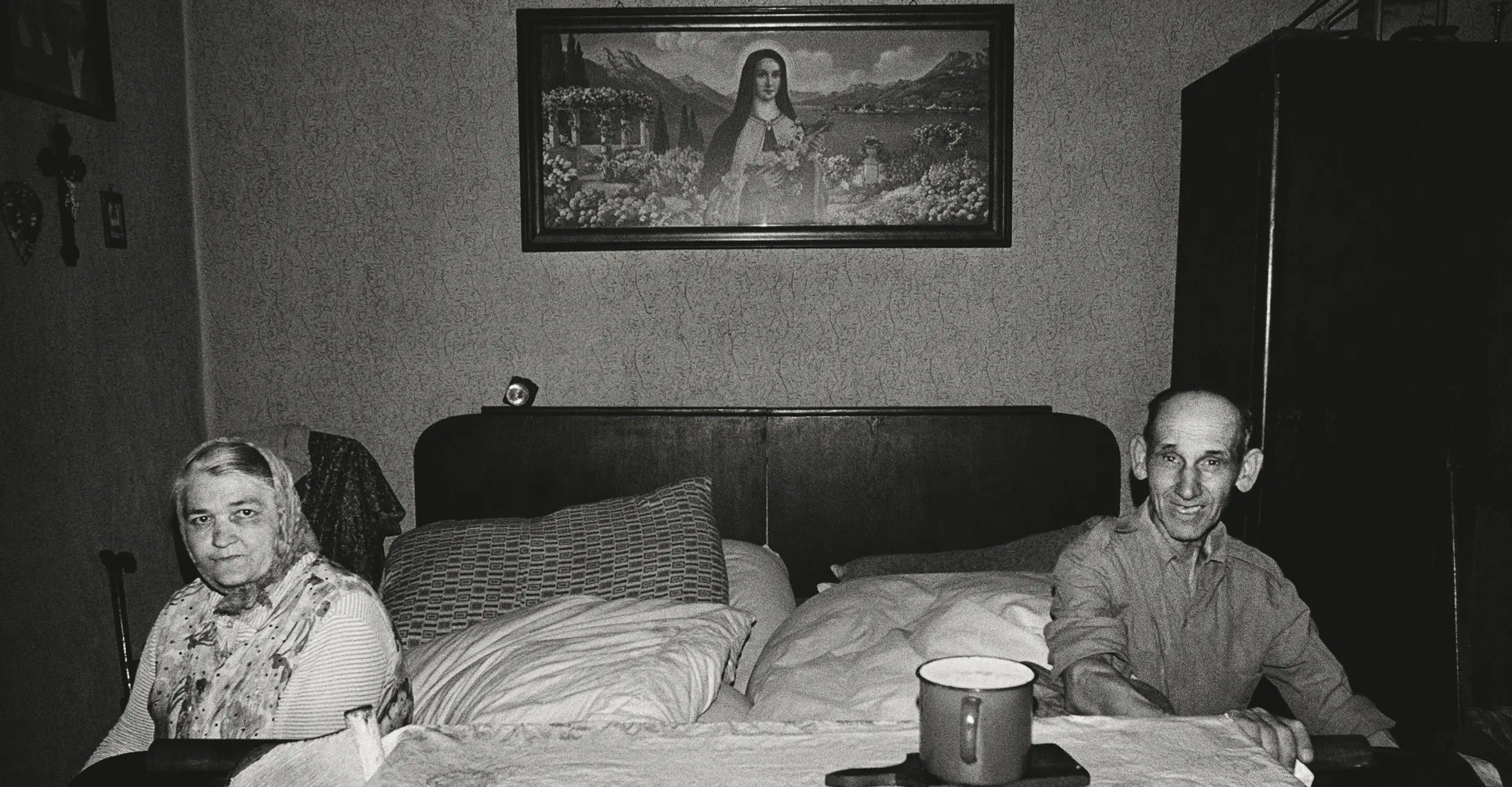
Online course | Visual Resistance and Politics of the Everyday: Photography in Eastern and Central Europe 1940s–Today
Wednesdays, 29 Oct to 10 Dec 2025 at 18.30-20.00 GMT on Zoom
This course examines the role of photography as a tool of resistance, documentation and imagination across Central and Eastern Europe. Moving beyond Western-centric frameworks, it highlights the intersections of gender, class and politics in photographic practice — tracing how artists have engaged with everyday life, socialist ideologies, underground subcultures, political upheavals and post-socialist transformations.
Across six sessions, we will engage with landmark projects, underexplored archives and contemporary feminist perspectives. Alongside close readings of artists’ works, the course will situate photography within broader theoretical contexts, drawing on key texts by Michel de Certeau, Henri Lefebvre, Gillian Rose and Griselda Pollock, among many others.
Led by Tereza Zelenková, whose own practice explores myth, memory and cultural identity, the course provides a unique opportunity to consider photography as both a witness to history and a medium of resistance and reimagining.
Course format
Taking place weekly over Zoom, all sessions will consist of a blend of slide-based lectures and guest speakers, followed by discussion. It will also be recorded for those not able to join live — recordings will be made available via a shared folder. Ticketholders will receive a link to the shared folder after the first session.
Who is this for?
Open to all who are interested in photography, sound and art, particularly those with a growing interest in history, archives and critical theory. No prior knowledge necessary.
Details on how to access the sessions will be confirmed upon registration. Please check your junk folders if you haven't received an email from TPG staff confirming your place.
Schedule
Session 1: Ethnographies and the Politics of the Everyday: Zofia Rydet’s Sociological Record in a Gendered Context on Wed 29 Oct
This session explores how the everyday — often seen as ordinary or neutral— is in fact shaped by power, care and gendered negotiation. Through Zofia Rydet’s Sociological Record and photographers from the region, we will examine domesticity, labour and visual ethics, asking how the “everyday” becomes political in art. This session will include group introductions and discussion.
Case studies in addition to Zofia Rydet include Irena Blühová, Dagmar Hochová and Anna Kutera.
Session 2: Labour, Bodies and Ideologies: Art Under Socialism on Wed 5 Nov
We will investigate how bodies, particularly women’s and working-class bodies, were represented, idealised and resisted in socialist visual culture. Looking at artists working under surveillance and censorship, the session asks what it meant to be a woman artist under socialism and how art could serve as both propaganda and critique.
Case studies include Běla Kolářová, Katalin Nádor, Maria Pinińska-Bereś, Zorka Ságlová and Endre Tót.
Session 3: Countercultures and Visual Resistance: Underground & Marginal Voices on Wed 19 Noc
This week turns to underground culture and spaces, where artists, feminist and queer voices found expression despite repression. We will consider zines, performance and other subversive practices as forms of embodied resistance and spaces for reimagining identity, sexuality and agency. We will look at the work of Orshi Drozdik, Libuše Jarcovjáková, Katalin Ladik, Mladen Stilinović and Goran Trbuljak.
Session 4: Witnessing and Revolt: Protest and Political Change on Wed 26 Nov
Focusing on moments of political unrest, this session examines who documents upheaval and whose perspectives are recorded. We will discuss women’s roles in the Solidarnost movement, the Velvet Revolution and beyond, while exploring the power and limits of photography as a witness and activist tool.
This week we will look at the work of Josef Koudelka, Bohdan Holomíček and Agata Madejska, among others.
Session 5: Post-Socialist Turns: Myth, Memory and the Archive on Wed 3 Dec
In this penultimate session, we look at how contemporary artists confront memory, myth and identity in post-socialist contexts. Through feminist perspectives on the archive, we will ask whose stories are preserved or erased, and how artists navigate new pressures of nationalism, capitalism and Westernisation.
Photographers and artists covered include Marina Gržinić & Aina Šmid, Jitka Hanzlová, Dorota Nieznalska, Joanna Piotrowska and Tereza Zelenková.
Session 6: Guest speaker Iren Stehli on Wed 10 Dec
In this final session, photographer Iren Stehli will present her work and reflect on her experiences as both afemale photographer and a Western outsider living and working in socialist Czech Republic. Following herpresentation and conversation with course tutor and artist Tereza Zelenková, the session will end a closingdiscussion to draw together key themes from across the weeks.
Biography
As the world outside accelerates, Tereza Zelenková's black and white analogue photographs evoke a sense of stillness and dust. Curious objects and historic interiors in her images become vessels of enigmatic narratives, evoking a world both familiar and hauntingly surreal. In her work, Zelenková brings together collections of images that speak to the palpable presence of history, where eclectic subjects transform into symbols, inviting viewers to unravel the mysteries that lie beneath their surface. Through her work, she reminds us that history is not just a series of events but a living, breathing entity that continues to shape our understanding of the world around us.
Tereza Zelenková has received several awards and her work has been exhibited on four different continents. Her photographs are held in the collections of Victoria & Albert Museum, Foam Photography Museum, Musée de l’Élysé, Saatchi Gallery and Fotomuseum Winterthur.
Her work was commissioned by The New Yorker, The Atlantic, The Financial Times and Hothsoe magazine, among others.
Bursaries
A number of partial bursaries covering 50 per cent of course fees will be awarded on a first come basis. Applicants who wish to be considered for a partial bursary should submit a statement (max. 500 words) to projects@tpg.org.uk, outlining how the course Visual Resistance and Politics of the Everyday: Photography in Eastern and Central Europe 1940s–Today would contribute to their professional development. Successful applicants will be notified within a week of submission.
We actively encourage applications from groups who are currently underrepresented in the cultural sector in the UK. This includes people who identify as D/deaf, disabled* and neurodivergent; those with caring responsibilities; candidates from Black, Asian and ethnically diverse backgrounds; and arts and culture professionals whose career development has been negatively impacted by Covid-19, prioritising independent artists, freelancers and those made redundant/at risk of redundancy since 2020.
*The Equality Act 2010 defines a disabled person as someone who has a physical or mental impairment, and the impairment has a substantial and long-term adverse effect on their ability to carry out normal day-to-day activities. Sharing that you are disabled will not be used in any way in judging the quality of your application.
Details on how to access this event will be confirmed upon registration. Please check your junk folders if you haven't received an email from TPG staff confirming your place.
Ticketing
By booking for this event you agree to our Terms & Conditions.


