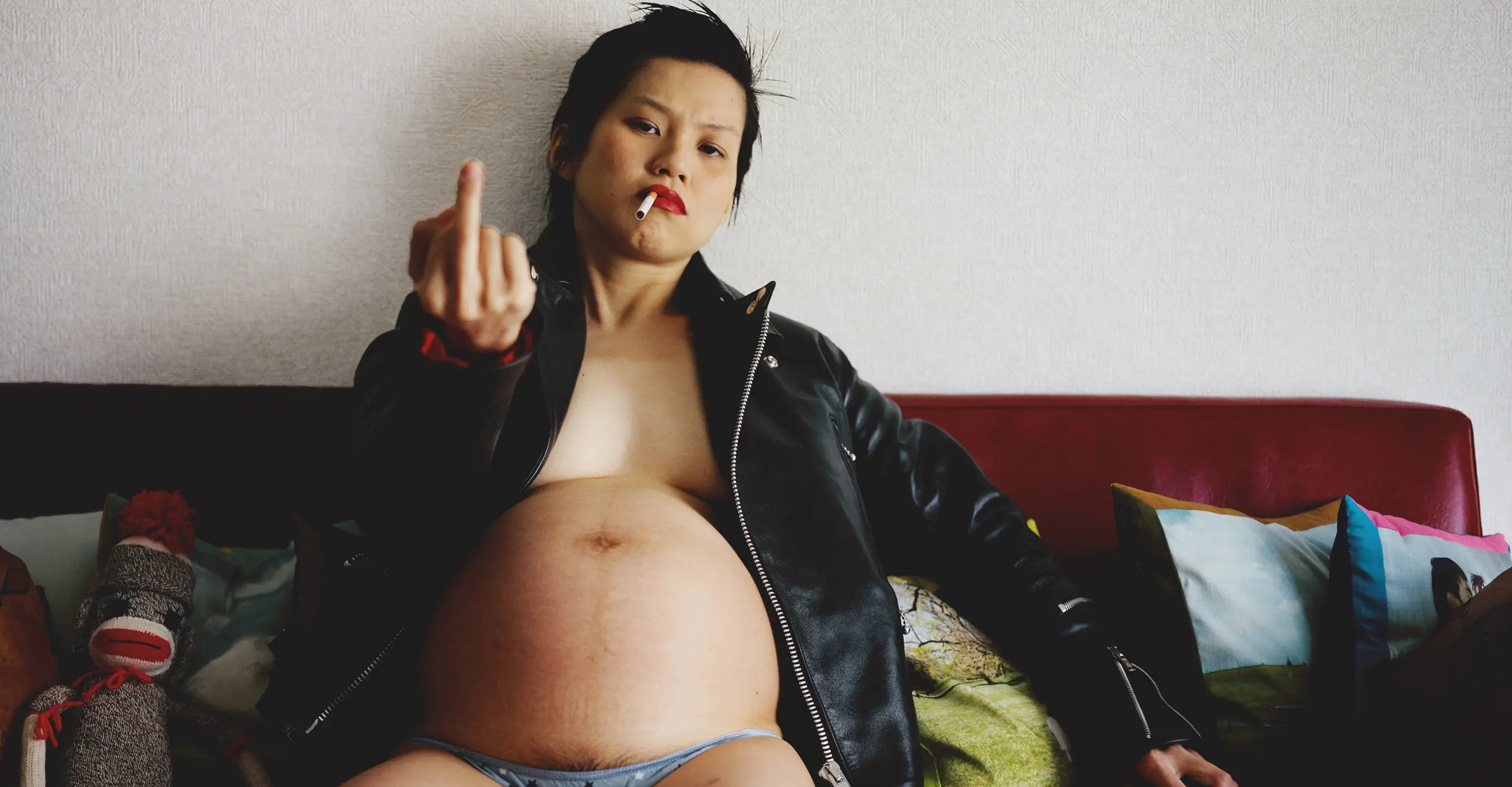
Since the 1970s, Japanese photography has become the subject of major books and international exhibitions, but recognition has primarily centred on male photographers such as SUGIMOTO Hiroshi, MORIYAMA Daidō and ARAKI Nobuyoshi.
- Introduction to I’m So Happy You Are Here: Japanese Women Photographers from the 1950s to Now, Aperture, 2024
Until recently, the work of women photographers in Japan had been overlooked or, in some cases, dismissed. For example, the controversial moniker ‘girl's photography’ (onnnanoko shashin), coined by male critics and the wider media, was a way of labelling the work produced by a group of women artists during the 1990s.
This one-day event reflects on the cultural, historical and political circumstances that led to a creative output of photographers making work in the 1990s and beyond. Their work continues to shape subsequent generations of artists. It also highlights the infrastructure and support that was available at that time.
Three artists from the Japanese Women Photographers exhibitions in London and Tokyo – IWANE Ai, NAGASHIMA Yurie and NARAHASHI Asako – speak about their practice. Each will also take part in a moderated discussion about their work in relation to the attitudes toward, and achievements of, women photographers in Japan. Writer, critic and photography curator TAKEUCHI Mariko looks at the wider conditions for women in Japan in her keynote talk.
By booking for this event, you agree to our Terms & Conditions
Schedule for the day
11:00am: Welcome & Introduction
Shoair Mavlian, Director, The Photographers’ Gallery and Sam Thorne, Director General and CEO, Japan House London
11:10am TAKEUCHI Mariko - Setting the Scene | Keynote
TAKEUCHI Mariko offers a context for this period of production in relation to women’s social, cultural and economic circumstances. She will touch on some of the work in the Japanese Women Photographers exhibition that preceded the 1990s, followed by a discussion with Jelena Stojković.
12:25pm: [break for lunch]
A short break.
1:10pm: NAGASHIMA Yurie - Dissident Women: Smashing the ‘Girls’ Photography’ (Onnna-no-ko Shashin) label | Presentation & Conversation
NAGASHIMA Yurie will revisit her photography in the 1990s through to the present, followed by a discussion with Bidisha on the production, dissemination and reception of her work.
2:25pm: NARAHASHI Asako - Ignoring Categorisation | Presentation & Conversation
NARAHASHI Asako will present her work that defies genre or format, followed by a discussion with MORIYAMA MASON Ayumi about her commitment to an alternative venue and publishing venture for her own and others’ work [03FOTOS and MAIN].
3.40pm: IWANE Ai - Paying Attention | Presentation & Conversation
IWANE Ai will speak about two ongoing projects in Lahaina (Hawaii) and California, and the work in her new book A New River, followed by an in-conversation with José Neves about the path her work has taken from the 1990s to now.
4:55pm: short comfort/set-up break
A short break as we prepare for the plenary.
5pm: Beyond Labels | Plenary session
A conversation with the four speakers chaired by Taous Dahmani
5:30pm: Close
Close, with an opportunity to look/re-look at the Japanese Women Photographers: from 1950s to Now exhibition.
Speaker biographies
IWANE Ai
IWANE Ai is a photographer who studied in the United States at Petrolia High School (1991), an alternative school located in Northern California, where she led an off-grid and self-sufficient life while studying. She began her career as a photographer in 1996. Initially working as a photographer for Japanese publications, she started focusing on Japanese culture in Hawaii in 2006.
Since 2011, she has been exploring the link between the United States and Fukushima by documenting experiences of migration and displacement. This project resulted in the book kipuka (Seigensha Art Publishing, 2018), which received the 44th Kimura Ihei Photography Award, the 44th Ina Nobuo Award and the 2022 Prix Pictet Japan Award.
NAGASHIMA Yurie
Photographer NAGASHIMA Yurie started her career as an artist/photographer with her series of everyday scenes of herself and her family at home in the nude, which earned her the PARCO prize from the open-call exhibition Urbanart#2 in 1993. NAGASHIMA has consistently documented her life through photography, capturing her own body and other communities.
She continues to establish her radical artistic language with a particular interest in gender and social-class issues in Japanese society and the Japanese photography world. Her master's degree thesis in Sociology laid the foundation for her 2020 manifesto From their "girls' photography" to our Girly Photo. In this text, she expresses deep frustration with the historians and photographers, all male, who in the 1990s had both promoted and critiqued the cohort of emerging women photographers, including herself, by reductively grouping them under the label "Onna-no-ko Shashin (Girls' Photography)”.
She is considered one of Japan's most critically minded contemporary artists and an ardent activist who questions and pushes boundaries while arguing for more profound thinking, understanding, and inclusion.
NARAHASHI Asako
NARAHASHI Asako is a photographer whose work spans a diverse range of themes, genres and formats. Before entering college, she experimented with photography, building darkrooms with friends to understand the possibilities of the medium. From 1985 to 1986 she made "photo diaries" consisting of small prints she produced in the thousands.
In the late 1980s, she travelled throughout Japan, visiting locations such as Aomori, Kyushu, the Izu Islands, and Okinawa, creating a series of black and white photographs. This work was exhibited in three separate exhibitions and, in 2023, this work was published as a book for the first time.
In 1990, NAHARASHI opened her own gallery in Tokyo, 03FOTOS, to present her work as well as that of fellow artists. In 1996, she co-founded main with the photographer ISHIUCHI Miyako. This self published magazine ran for four years and featured their work, along with contributions from, and interviews with, others.
Her decades-long career has been the published and exhibited, garnering national acclaim and international recognition.
TAKEUCHI Mariko
Moderator & Chair biographies
Jelena Stojković - Moderator (with TAKEUCHI Mariko)
Jelena Stojković is an art historian and critic based in London. She is the author of The Impossible Avant-Garde: Surrealism and Photography in 1930s Japan (2020) and a co-editor of Women Artists and Abstract Art in Postwar Rome: Connected by Travel (2026). She is a Senior Lecturer in Critical Studies at the School of Arts, Oxford Brookes University.
Bidisha - Moderator (with NAGASHIMA Yurie)
BIDISHA is a presenter and arts journalist. She writes for the main UK broadsheets, chairs events and appears extensively across the BBC, CNN, Channel 5, ABC and Sky News. Her most recent publication is The Future of Serious Art. She served as Trustee for the Forward Prizes for Poetry, the PANDA Performing Arts Network and the Booker Prize Foundation and scouts across film, TV, art, design, literature, media and performance projects.
She is also an acclaimed art director and maker of photographic stills and films, having started her career working for style magazines in the 90s. Her first short film, An Impossible Poison (2017) was selected for multiple international film festivals. Her short film series Aurora ran from 2020-2023. Her stills were shortlisted for the Taylor Wessing Photo Portrait Prize in 2025 and 2026 and are in numerous private collections internationally.
MORIYAMA MASON Ayumi - Moderator (with NARAHASHI Asako)
MORIYAMA MASON Ayumi began her career in Japan as a portrait photographer, at a time when relatively few Japanese women worked as commercial photographers. She later worked alongside renowned still-life photographer Tetsuro Takai, whose expertise in studio lighting helped shape her approach to commercial photography, combining visual storytelling with refined studio craft. She also works in The Photographers’ Gallery Bookshop.
José Neves - Moderator (with IWANE Ai)
José Neves is Assistant Curator at The Photographers' Gallery. Previously a Curator at Belfast Exposed Photography in Northern Ireland, José organised exhibitions featuring artists like Jo Spence, Frits de Ridder, Arpita Shah, and Yvette Monahan. He earned a PhD in Photographic History, specialising in photobook history, from Ulster University in 2017. Previously, he studied Photographic History and Practice at De Montfort University in Leicester and worked as an Assistant Curator at the Wilson Centre for Photography in London.
Taous Dahmani - Chair of Plenary session
Taous Dahmani is a London-based French, British, and Algerian art historian specialising in photography and Curator at The Photographers' Gallery. She has curated both group and solo exhibitions internationally, including the 2022 Louis Roederer Discovery Award at Les Rencontres d’Arles and the 2024 Jaou Photo Biennale in Tunis. Her solo curatorial projects include SMITH at NOUA in Bodø, Norway, Anastasia Samoylova at the Saatchi Gallery, and Adam Rouhana at Kyotographie.
Event interpreters
ETSUZEN Kozue
ETSUZEN Kozue is a London-based Japanese-English translator, interpreter and media coordinator with a particular interest in arts, photography, music and cultural exchange between Japan and the UK. She has interpreted for a wide range of leading cultural institutions and events, including the Southbank Centre, Hayward Gallery, Victoria and Albert Museum, BAFTA and the BFI London Film Festival.
Her work has also brought her close to the world of photography and music history. She was the producer of the photography exhibition Give Peace A Chance: John & Yoko’s Bed-in 1969 and translated Yoko Ono’s poetry collection Acorn into Japanese. She has also worked as a correspondent for the John Lennon Museum in Saitama, Japan, combining interviews with photographic reporting. She is a Beatles specialist and a regular contributor to books and magazines on the subject.
KURASAWA Eyre
KURASAWA Eyre is a bilingual Japanese–English interpreter with 15+ years of global experience. Her work spans across the creative industries — arts, media, entertainment, and publishing — alongside sectors as varied as technology, pharmaceuticals and renewable energy. Her background in acting and writing informs her approach, bringing nuance and deeper sensitivity to every project
Beyond Labels: Japanese Women Photographers event is supported by Japan House London Trust; Daiwa Anglo-Japanese Foundation; and The Great Britain Sasakawa Foundation.
This event is programmed in connection to the exhibition I'm So Happy You Are Here: Japanese Women Photographers 1950s to now, curated by Lesley A. Martin, Takeuchi Mariko and Pauline Vermare. The exhibition was organised by Aperture in collaboration with the Rencontres d’Arles with support from Kering | Women In Motion, Ishibashi Foundation, Anne Levy Charitable Trust,1970 Japan World's Exposition Memorial Fund and The Great Britain Sasakawa Foundation. Additional curatorial collaboration for the exhibition in London, with Taous Dahmani, The Photographers’ Gallery.