Audio description in galleries and museums aims to make visual information accessible using verbal description. The Photographers' Gallery has, for several years, also linked audio description to slow looking and to visual literacy.
The audio files for four audio descriptions for four works in the exhibition are below, alongside narrated artist bios. A transcript of each audio description is also available.
These audio descriptions have been produced by Eleanor Margolies, a writer and audio describer. She has a background in puppetry and theatre design, with interests in ecology and the role of the senses in performance. She audio describes in museum, theatre and dance contexts.
About Deutsche Börse Photography Foundation Prize 2026 exhibition
The Prize, originally established in 1996, identifies and rewards artists for an exhibition or book that has made a significant contribution to photography in the past 12 months.
Jane Evelyn Atwood
Jane Evelyn Atwood (b. 1947, New York, USA) is shortlisted for her publication Too Much Time / Trop de Peines, a revised, bilingual reprint of two works originally published in 2000 and updated by Le Bec En L’Air, Marseille in 2024.
Transcript
Perm Penal Colony for Women, Perm, Russia, 1990 from the series Too Much Time by Jane Evelyn Atwood
This black and white photograph in landscape format by Jane Evelyn Atwood
shows a moment in the everyday life of a prison. It is entitled: ‘Inmate serves boiled water instead of tea or coffee to prisoner in solitary confinement. Perm Penal Colony for Women, Perm, Russia, 1990.’ It’s 26.5 centimetres tall by 40 centimetres wide.
In the middle of the photograph, just slightly to the right of centre, there is a small hatch in a metal door, a little smaller than a sheet of A4 paper. The door of the hatch is opened towards us and rests flat against the cell door. Through the opening, the delicate hands of an unseen prisoner hold out a tin mug.
The left-hand side of the photograph is filled with the torso of a prison warder, a male figure with a large belly, wearing an apron over cotton overalls. His upper arm runs horizontally along the top edge of the photograph as he raises it to pour something into the prisoner’s cup from a matching tin mug. In his left hand, he holds a white enamel bucket, presumably full of water. His head is not visible.
The photograph centres on the contact between two mugs: one angled, held lightly from above by a single finger, the other, held steady by both hands, in an upright position to receive the liquid. The gesture suggests communion, but it is framed by the heavy apparatus that separates prisoner and guard.
The inner side of the hatch door is battered, the paint flaked off and the metal dented, suggesting that over a long period of time, the prisoners have bashed mugs or cutlery against the hatch. It can only be opened from the outside.
Above the hatch, there is an oval metal disc, presumably the cover for a spyhole to observe the prisoner. To the left of the hatch, there is a metal handle, firmly bolted to the door, along with other metal blocks and pipes that seem to be part of the system for locking the door.
--
Jane Evelyn Atwood was born in 1947 in New York, USA. She is shortlisted for her publication Too Much Time / Trop de Peines, a revised bilingual edition of two works originally published in 2000 and updated by Le Bec en l’air, Marseille, in 2024.
Renowned for her humanistic approach to long-term documentary projects, Atwood’s work focuses on the lives of people who are disempowered and overlooked in society.
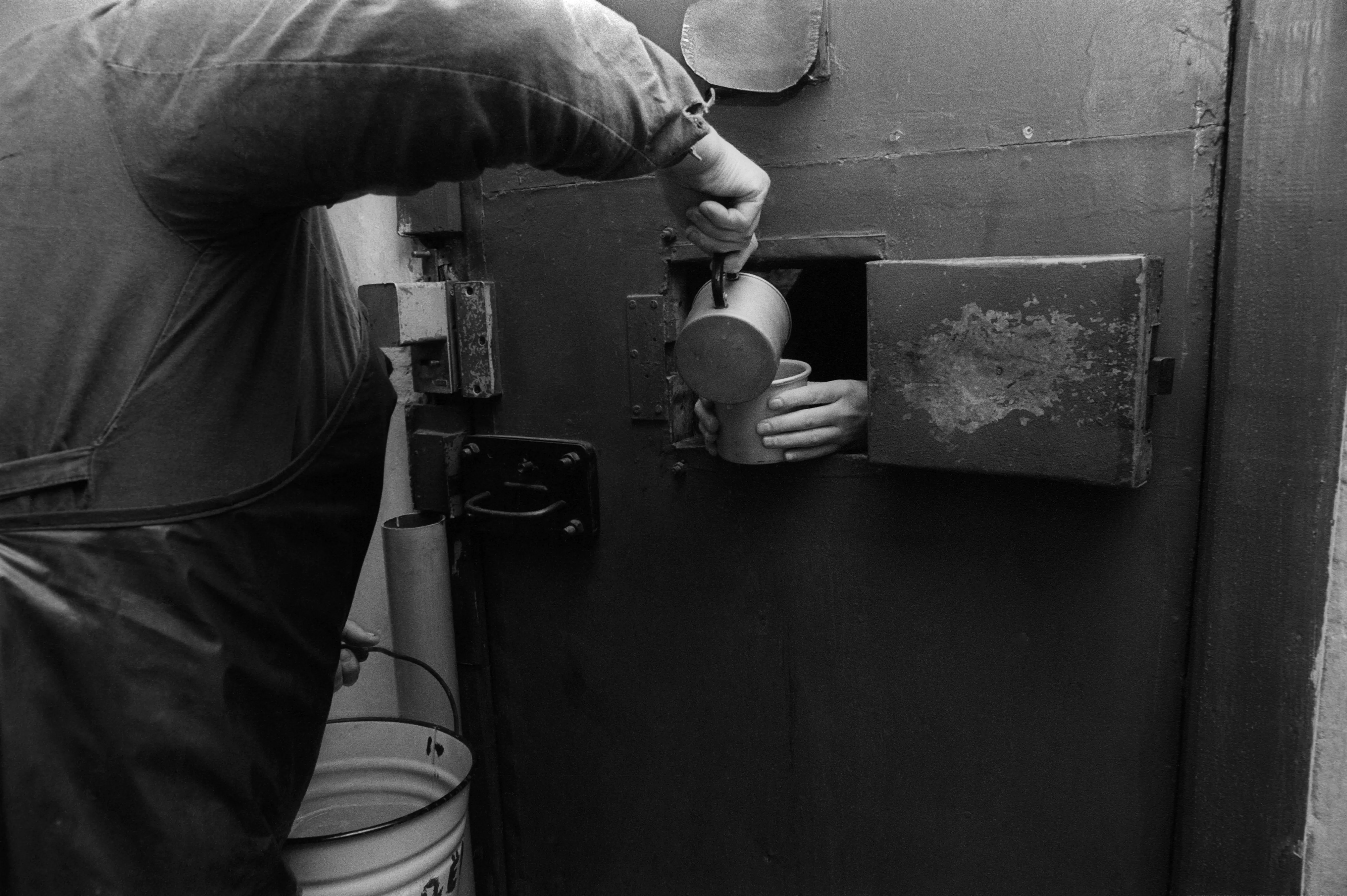
Jane Evelyn Atwood, Inmate serves boiled water instead of tea or coffee to prisoner in solitary confinement. Perm penal colony for women, Perm, Russia, 1990
© Jane Evelyn Atwood
Weronika Gęsicka
Weronika Gęsicka (b. 1984, Włocławek, Poland) is shortlisted for the publication Encyclopaedia, published by BLOW UP PRESS and Jednostka Gallery in November 2024.
Transcript
Lipid Therapy, from the series Encyclopaedia (2019-2025) by Weronika Gęsicka
In this colour photograph by Weronika Gęsicka is in landscape format, 50 centimetres by 40. A woman lies back on a treatment couch. A tangle of plastic tubes, filled with red liquid, sprout from her head, as if she’s undergoing a complicated medical or cosmetic procedure. The hand of a professional behind her head seems to be making some adjustment to the equipment.
The photograph evokes a film still from the middle years of the twentieth century, perhaps a sci-fi film: it is vividly coloured, with the woman’s head and the tentacles of tubing in focus, and some mysterious equipment and a cubicle curtain out of focus behind her. The woman is in her thirties, with her head pillowed on two puffs of luxuriant brown hair. She’s carefully made up, with blood red lipstick matching the liquid in the tubes, shimmering eye shadow and arched eyebrows above large brown eyes. She’s looking up, with a touch of anxious frown.
Her scalp and forehead seem to be covered with a translucent plastic cap, which extends down over her cheek on the right-hand side, with an opening cut out for her eye.
Eight red plastic tubes are attached to this plastic cap, as if feeding into her skull, with clear plastic reservoirs of liquid attached to them. The red pipes end in red plastic caps that add to the impression of something sprouting mushroom like from the woman’s head.
A disembodied hand coming from the right-hand side of the photograph grips one of these tubes firmly – is it to assist or to interrupt the mysterious treatment? The sprouting tubes might recall the figure of Medusa from Greek mythology, who had writhing snakes instead of hair, but this woman’s gaze is averted from us, not threatening to turn us to stone.
--
Weronika Gęsicka was born in 1984, in Włocławek, Poland and graduated from the Graphics Faculty of the Academy of Fine Arts and the Academy of Photography in Warsaw. She is shortlisted for her 2024 publication Encyclopaedia.
Trained in graphic arts, Gęsicka brings an analytical and multidisciplinary approach to her artistic practice. Her work examines how we remember and reproduce the past through photography.
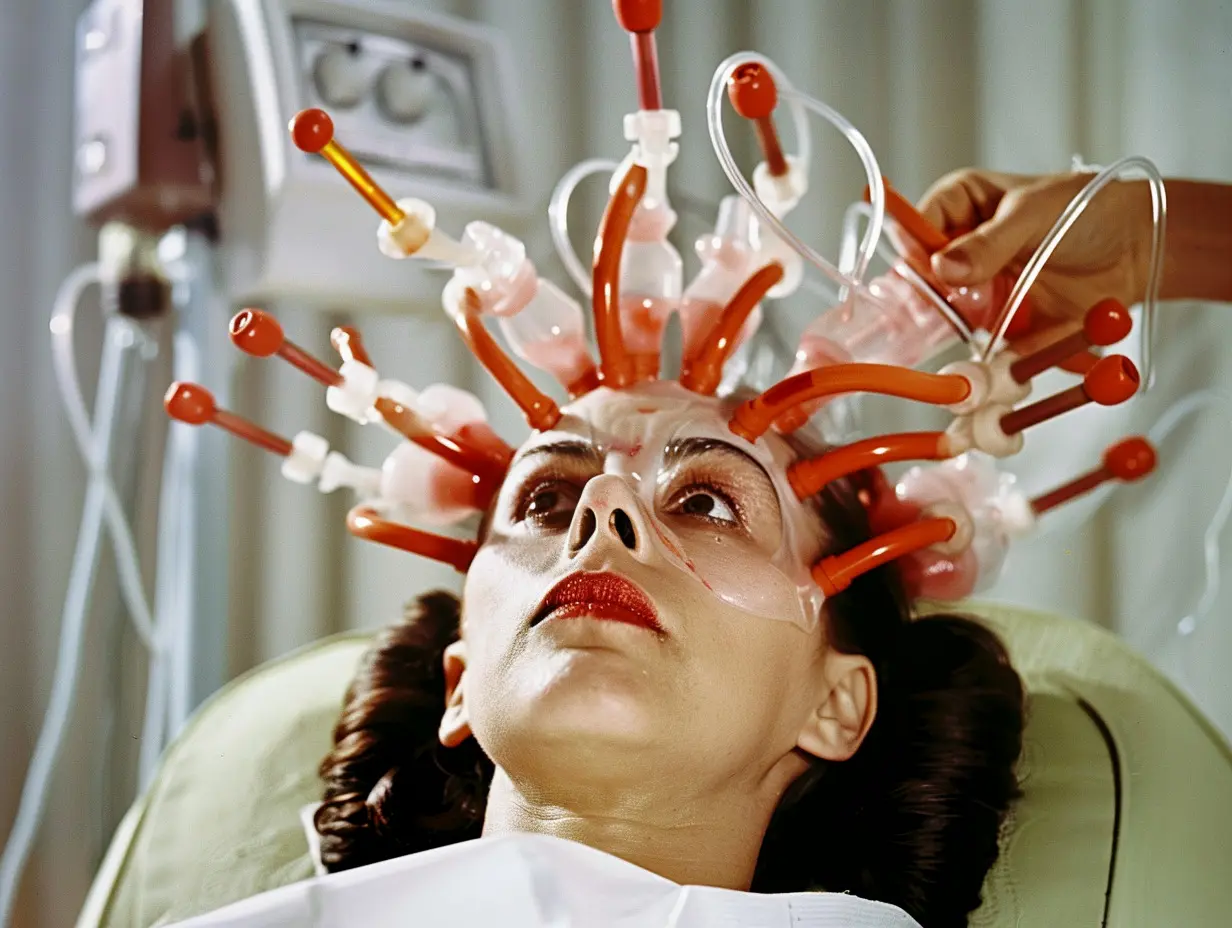
Weronika Gęsicka Lipid therapy From the series ‘Encyclopaedia’, 2023-2025 Courtesy of the artist and Jednostka Gallery
Amak Mahmoodian
Amak Mahmoodian (b. 1980, Shiraz, Iran) is shortlisted for the exhibition One Hundred and Twenty Minutes at the Bristol Photo Festival, UK, in collaboration with Multistory (16 October – 17 November 2024).
Transcript
Untitled from the series One Hundred and Twenty Minutes (2019-2024) by Amak Mahmoodian
‘In my dream, my sister has twins. My sister and her husband couldn’t conceive a child, but they cared for me as their own.’
In this large black and white photograph in portrait format, nearly a metre high and 70 cm wide, a woman stands facing us, behind a net curtain. She cradles a baby doll in each arm; the dolls are on our side of the curtain.
The woman stands with her back to a window. A pale net curtain falls in front of her face – she appears to have dark wavy hair, and her chin is lifted, but her features are blurred. Her hands are together at waist height, the draped fabric reminiscent of statues and paintings of the Virgin Mary. In the crook of each arm, she holds a newborn baby. On closer examination, it is clear that the naked babies are dolls – their heads are upright, and rigidly self-supporting, quite unlike the floppiness of real babies.
The woman is framed by heavier curtains pushed to the sides of the window. They are of plain fabric, in a simple style, with large eyelets looped onto a metal curtain rail, and are not completely symmetrical, with the right curtain slightly more spread out than the left one. The edges of the curtain are slightly puckered, and the walls behind are pale.
Above the curtain rail, a narrow strip of ceiling runs across the top of the photograph. At the bottom, hiding the woman’s lower legs and feet, there is a similar horizontal band. This is a patchwork quilt of patterned fabrics, spread over a bed.
The motif of the veiled mother may recall the so-called ‘hidden mother’ genre of Victorian photography, the convention of photographing children with their mother who was however veiled or covered in a blanket. But this photograph is Mahmoodian’s reconstruction of another person’s dream, as part of the series One Hundred and Twenty Minutes, the title referring to the average amount of time spent dreaming each night.
--
Amak Mahmoodian was born in 1980 in Shiraz, Iran. She is shortlisted for her exhibition One Hundred and Twenty Minutes part of the Bristol Photo Festival in 2024. Although Amak Mahmoodian would not call herself an activist, her work is deeply political, functioning as a visual protest.
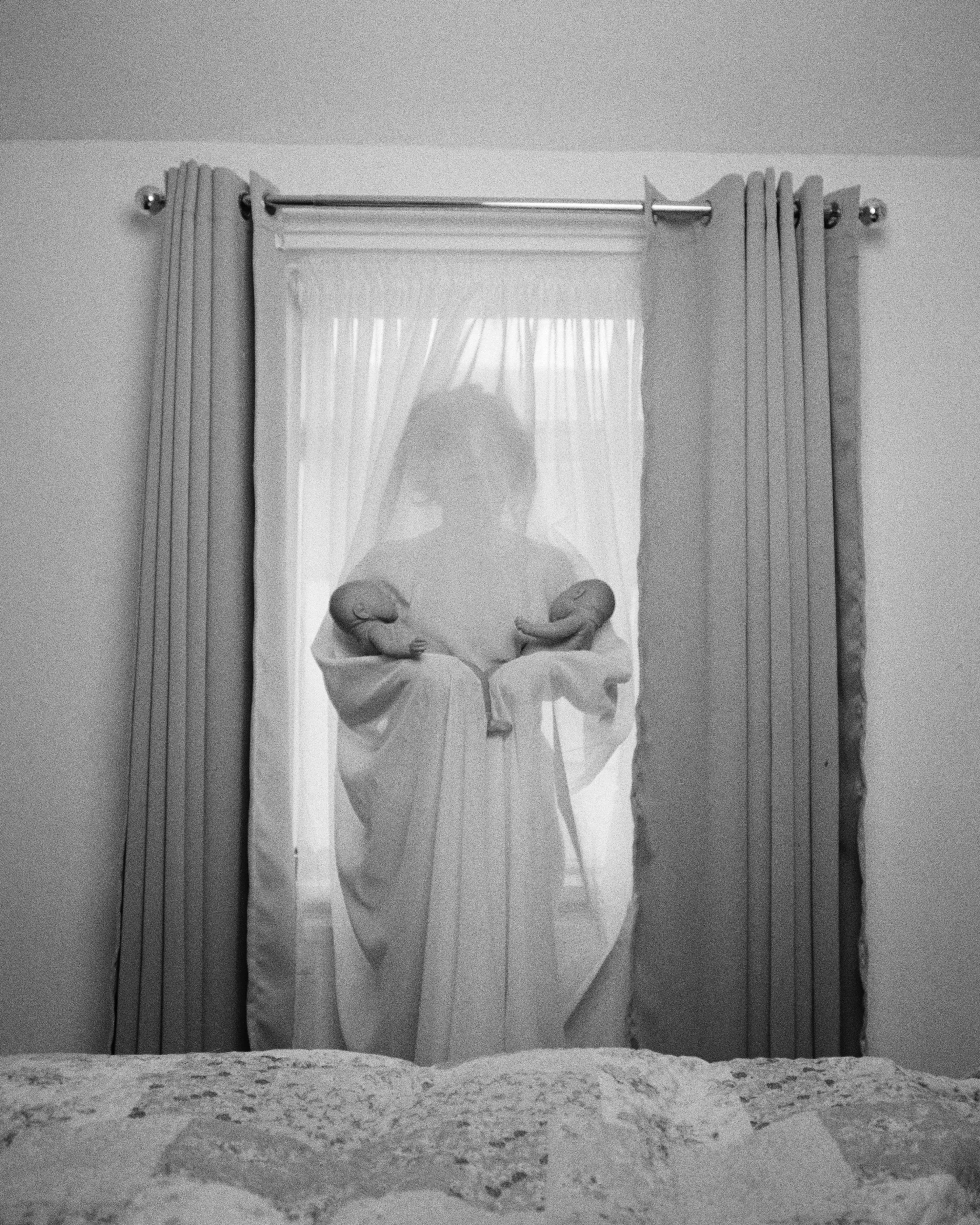
Amak Mahmoodian One Hundred and Twenty Minutes, 2019-2024. Courtesy of the artist
Rene Matić
Rene Matić (b. 1997, Peterborough, UK) is shortlisted for the exhibition AS OPPOSED TO THE TRUTH, at CCA Berlin, Germany (8 November 2024 – 15 February 2025).
Transcript
Untitled, from the series Feelings Wheel by Rene Matić (2022-2024)
‘Campbell's birthday meal’ is a colour photograph in portrait format by Rene Matić. The camera points directly down at a half-eaten chocolate cake on a plate in a restaurant, with other objects around it helping to tell the story.
The small cake plate is positioned just below the centre of the photograph and fills about one sixth of the image. The plate has a floral pattern in pink and green, with a geometric border. The chocolate cake looks homemade, with an uneven layer of chocolate icing that reflects the light.
The plate sits on a white paper tablecloth with red and yellow food stains, and a scatter of cake crumbs. Around and tucked under the plate, there are six thin birthday candles in white plastic holders, the wicks burnt. There’s also a square of gold paper with the words ‘Thank You’ printed in scrolling lettering – perhaps the wrapper of a complimentary mint thin. To the right of the plate is a square of foil that could be the inner part of the chocolate wrapper.
To the left of the cake plate, there is the rim of another plate from the same set. A knife smeared with cake rests on it. The rest of the plate and knife are out of view, beyond the left edge of the photograph.
A hand rests on the table above the cake plate, two of the fingertips disappearing under the rim of the plate. There are silver rings on three of the fingers, and the nails are short. On the back of the hand, there’s a blue ink tattoo, an outline drawing of a bulldog with a slightly surprised expression. The hand rests on one corner of a mustard yellow folded cloth, perhaps a napkin, in the top left-hand corner of the photograph.
In the top right-hand corner, there’s a small black plastic tray, holding a printed bill and £1.31 in coins, with the decorated handle of a piece of cutlery resting on it. The bill is facing in the direction of the owner of the hand and is headed with the name of the restaurant, ‘The Famous Curry Bazaar’, with an address on Brick Lane, phone number and web address. The date and time are given as 23 April 2024, 8: 21PM with the information that the bill refers to Table 12 where there were 4 guests. There’s a list of dishes, including Tarka Dal, Saag Aloo, rice and naan, and a total of £82.69.
This photograph appears as part of a larger installation. It is one of a selection of Rene Matic’s images documenting everyday life that are sandwiched between glass plates. The overlapping plates lean against the walls of the room, surrounding the viewer with an informal frieze of people, places and events.
--
Rene Matić was born in 1997 in Peterborough, UK to an English mother and an Irish-St Lucian father, and holds a BA in Fine Art from Central Saint Martins. Matić interrogates what it means to be British from a queer, mixed-race perspective, critically addressing concepts of heritage and racial politics. They are shortlisted for an exhibition entitled AS OPPOSED TO THE TRUTH, held at CCA Berlin.
Through photography, film, sculpture, and writing, Rene Matić explores what it means to live in-between: between identities, histories, and places of belonging.
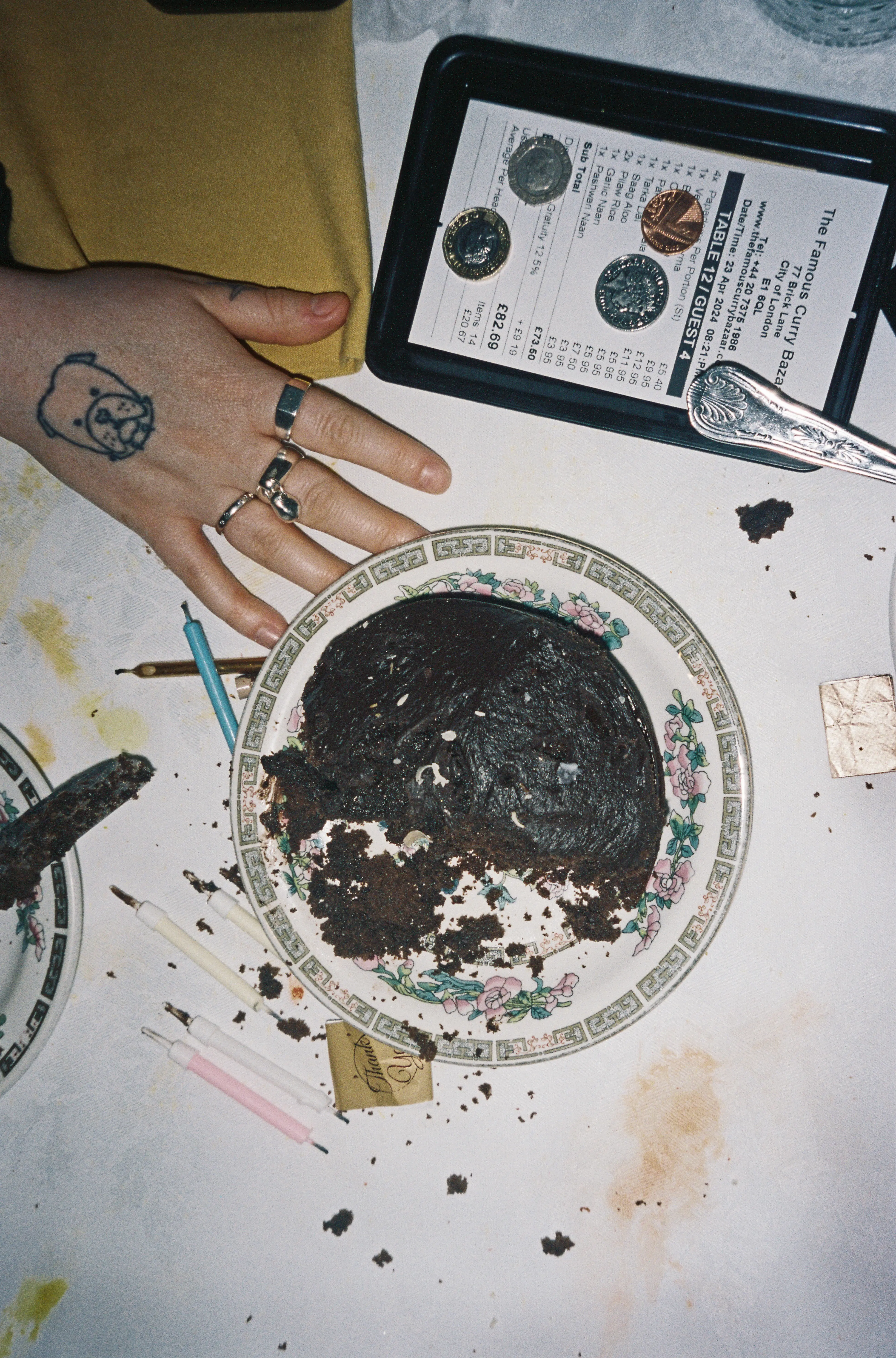
Detail: Rene Matić Feelings Wheel, 2024 - 2025 Installation of glass-framed photo series and sound piece, Dimensions variable. © Rene Matić. Courtesy the Artist and Arcadia Missa, London