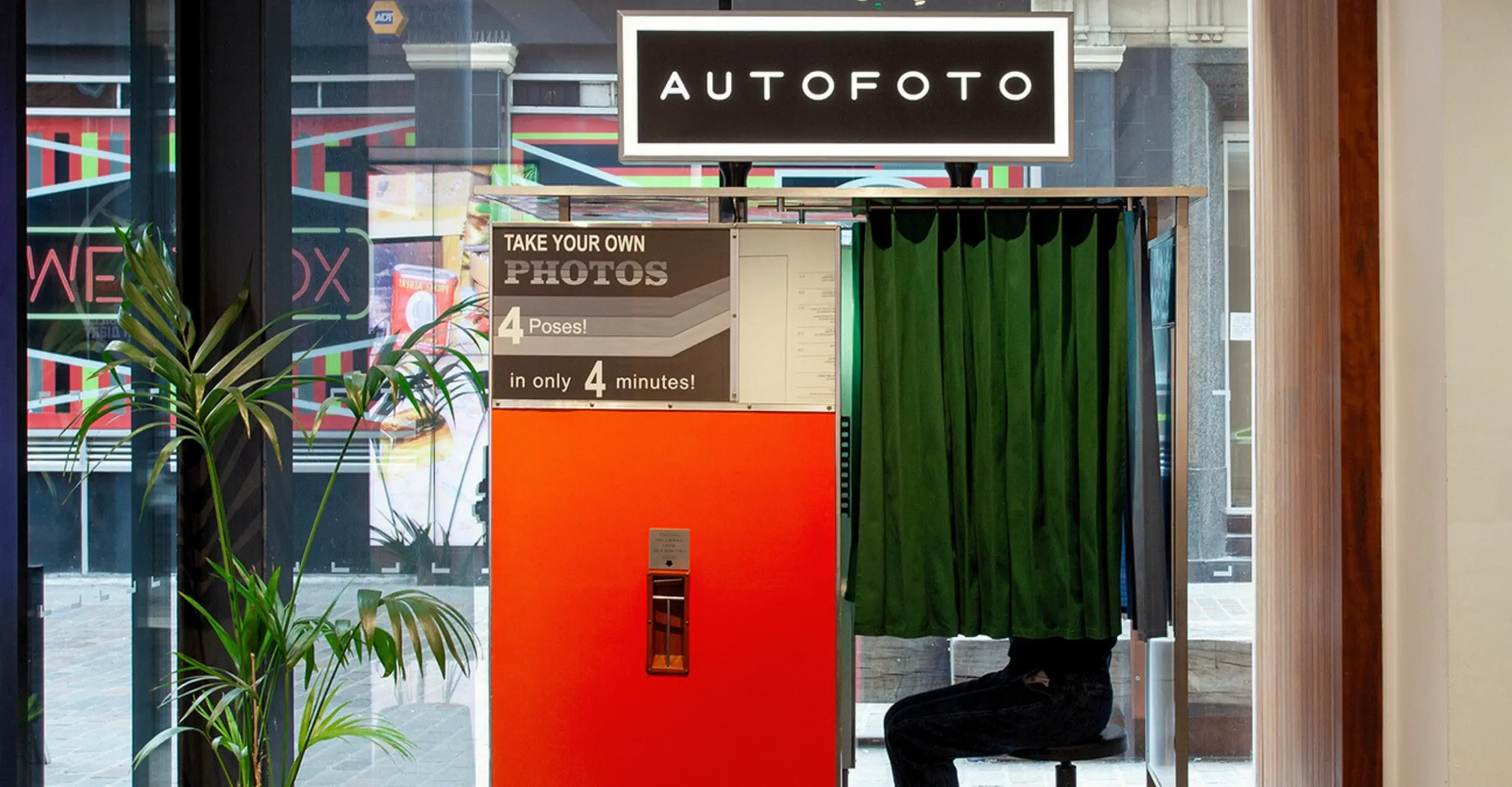
We recently celebrated the centenary of the photobooth in Strike a Pose! 100 Years of the Photobooth which explored the history, imperfections and quirks of the much loved booth. We're delighted our Autofoto 1960s analogue photobooth, originally used in Los Angeles, is here to stay. So next time you visit, take a seat and strike a pose!
While you wait for your photos to develop, watch the live feed of mechanics of the booth in action.
Analogue photobooths have special quirks - to get the most from your pictures, follow the instructions in the booth and here are a few tips...
- Be ready! The booth starts as soon as you pay, so adjust the stool if you need to before you pay – you’ll see a red light before each flash
- Don’t get too close to the glass and sit in the middle of the stool – otherwise you might be out of focus
- Use the white background (no background curtain) if you have darker skin or if you’re wearing dark clothing
- Use the background curtain if you have light skin tone or hair, or if you’re wearing white or pale clothing
- Have a little patience! It takes 4 minutes for your photostrip to be developed. It may be wet – this is just the water used to rinse off the development chemicals.
Don't forget to show us your pictures! If you share your photostrip on socials, please tag @thephotographersgallery
How an analogue Autofoto photobooth works
From the outside, the photobooth process appears simple; customers sit down, pay with a card and pose as the camera flashes. After four minutes the photo strip is deposited in a delivery unit on the outside of the booth and the happy customer goes on their way.
Inside however, hidden from view, is a carefully orchestrated system of electromechanical parts, gears, solenoids, relays, and switches all working in a perfect symphony.
On receiving payment, the mechanical camera inside the booth kicks into gear pulling a strip of paper from a large roll enclosed in a light-tight chamber. This strip of negative-to-positive silver gelatin photographic paper is placed in front of a prism that properly orients the image. A focal plane shutter turns as the paper moves across each flash.
When the photography process is complete, a spider assembly on top of a transmission flips out an arm. The arm takes the paper strip and moves it through a merry-go-round of tanks, dipping and dunking it in water baths, developer, bleach, clearing agent, and finally toner. Once it has been submerged in each tank, the arm drops the finished strip into a delivery unit outside of the booth where it is collected by the customer.
With so many moving parts, errors and mistakes are common, but we believe that it’s these tiny imperfections – blurred patches, discolourations and areas of over exposure – that bring an inimitable beauty to the photobooth images.
You can watch a livestream of the process inside our very own Autofoto analogue photobooth on a specially installed display.
In partnership with Autofoto