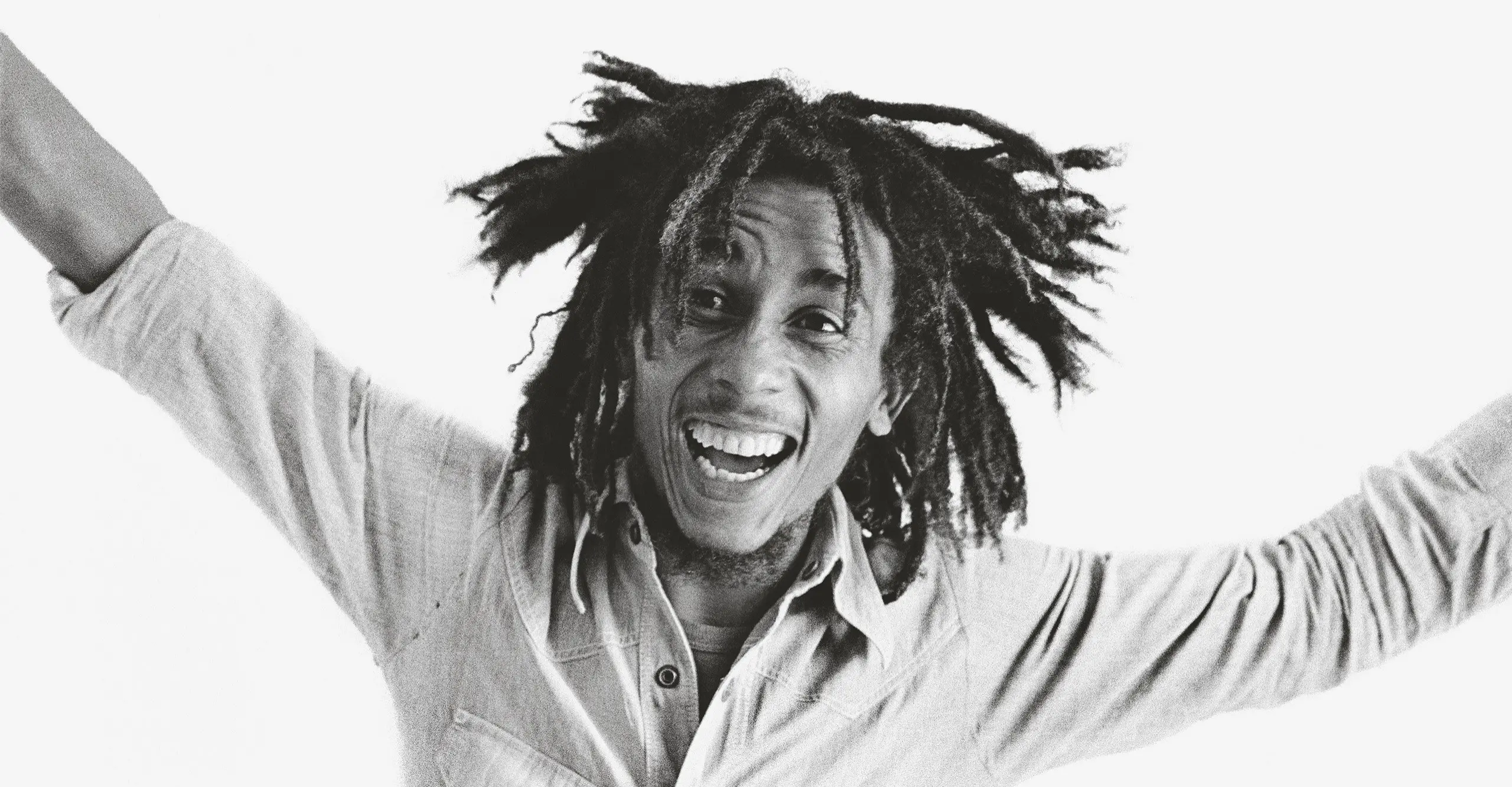
Audio description in galleries and museums aims to make visual information accessible using verbal description. The Photographers' Gallery has, for several years, also linked audio description to slow looking and to visual literacy.
The audio files for an introduction to the exhibition and five audio descriptions for five works in the exhibition are below. A transcript of each audio description is also available.
These audio descriptions have been produced by Eleanor Margolies, a writer and audio describer. She has a background in puppetry and theatre design, with interests in ecology and the role of the senses in performance. She audio describes in museum, theatre and dance contexts.
About Dennis Morris: Music + Life
Celebrate the work of British-Jamaican photographer Dennis Morris. Renowned for his intimate portraits of cultural icons such as Bob Marley, the Sex Pistols and Marianne Faithfull, Morris’ images are a vivid exploration of music, identity and social change.
Music + Life captures the spirit of some of the most pivotal moments in 20th-century culture, from the soulful vibrancy of reggae to the rebellious energy of punk. Morris provides a rare glimpse into the lives of legendary musicians, revealing the trust and connection he forged with his subjects. His candid photographs of Bob Marley, both on stage and off, along with the raw, chaotic world of the Sex Pistols, illustrate his unique ability to capture the personalities behind the music.
Transcript - Introduction
British-Jamaican photographer Dennis Morris is renowned for his documentary work – including Growing up Black, Southall and This Happy Breed – as well as for his intimate portraits of cultural icons such as Bob Marley, the Sex Pistols and Marianne Faithfull. The photographs in the exhibition Music + Life reveal the trust and connection Morris forged with his subjects.
Born in Jamaica in 1960, he later moved with his mother to Hackney in East London and became interested in photography at the age of nine, through a church choir club. Morris was only 11 when one of his photographs of a PLO demonstration was printed on the front page of the Daily Mirror.
His long and fruitful collaboration with Bob Marley began when he was just 14. He bunked off school and asked Marley if he could photograph him at a London gig – and Marley invited him to join the tour. Of their lifelong partnership, he has said, ‘It was much more than just taking the photos. It was a teaching, a learning, a growing.’
Music + Life also highlights Morris’ early documentary work, which reflects everyday life and Black British culture in the multicultural neighbourhoods of post-war London. As Gary Younge has written, in Morris’s photographs ‘he transforms black Britons from objects to subjects, and from recipients of hospitality to cultural agents. We see not just a group of people shaped by their presence in Britain but shaping it’.
Transcript - The Four Aces Club
In this black and white photograph, two young men look out at us, surrounded by a large sound system.
They are in a room with a black ceiling covered in lighting and ventilation panels, and a floor of mismatched tiles. In the centre of the photograph, in the corner of the room, there is a tall speaker – shoulder-height. The front has been hand-painted, almost circus-style, with vertical stripes and the name ‘Count Shelly’ in capital letters that curve around the huge disc of the woofer, some 15 inches in diameter, painted like the moon. ‘Sounds’ is painted underneath in a cursive style. At the bottom, a painted sun is reflected in the sea and, above this, two stars either side of a moon complete the decoration. On top is another big speaker, this one wedge-shaped, reaching to the ceiling.
To the left, a record player sits on a solid metal amplifier with five control knobs. It’s equipped with casters and handles so the weighty box can be moved around more easily. Count Shelly stands by it, leaning one arm casually on the amp. He’s in his twenties, wearing a wide cloth cap with a brim, velvet jacket over open-necked patterned shirt and flared trousers, and several rings on his fingers. Behind him is a white speaker box made of wood, taller than he is, the size and shape of an industrial washing machine, with a disc of mesh over a cone that must be 20 inches across and a scuffed-up base.
On the opposite side, a large wooden box for transporting records rests on a bench. It has padlocks and handles on the sides for transporting it securely. There are three black vinyl discs – 10 and 12 inch – propped up on the open lid. A young man sits beside the box, proprietorially resting an arm on it. He seems a bit younger than Count Shelly, and has a small afro, and wears a V-necked striped top under a velvet jacket, with flares.
This photograph comes from the series 'Growing Up Black', a visual record of Morris’s youth in Hackney in the 1970s. Ephraim Barret or ‘Count Shelly’ was a pioneering sound system operator and record label producer based in Hackney who later left London for New York to open his Super Powers Records shop in Brooklyn. At the time of this photograph, Count Shelly was a resident DJ at the Four Aces Club in Dalston Lane which attracted crowds from all over London. Hugely popular for its sound clashes that saw the crews of different sound systems compete with one another, the club also had a reputation for being somewhat rough. According to Morris, who was only 16 or 17 at the time, the Four Aces was 'for the big boys, big men. To go there you had to be tough.'
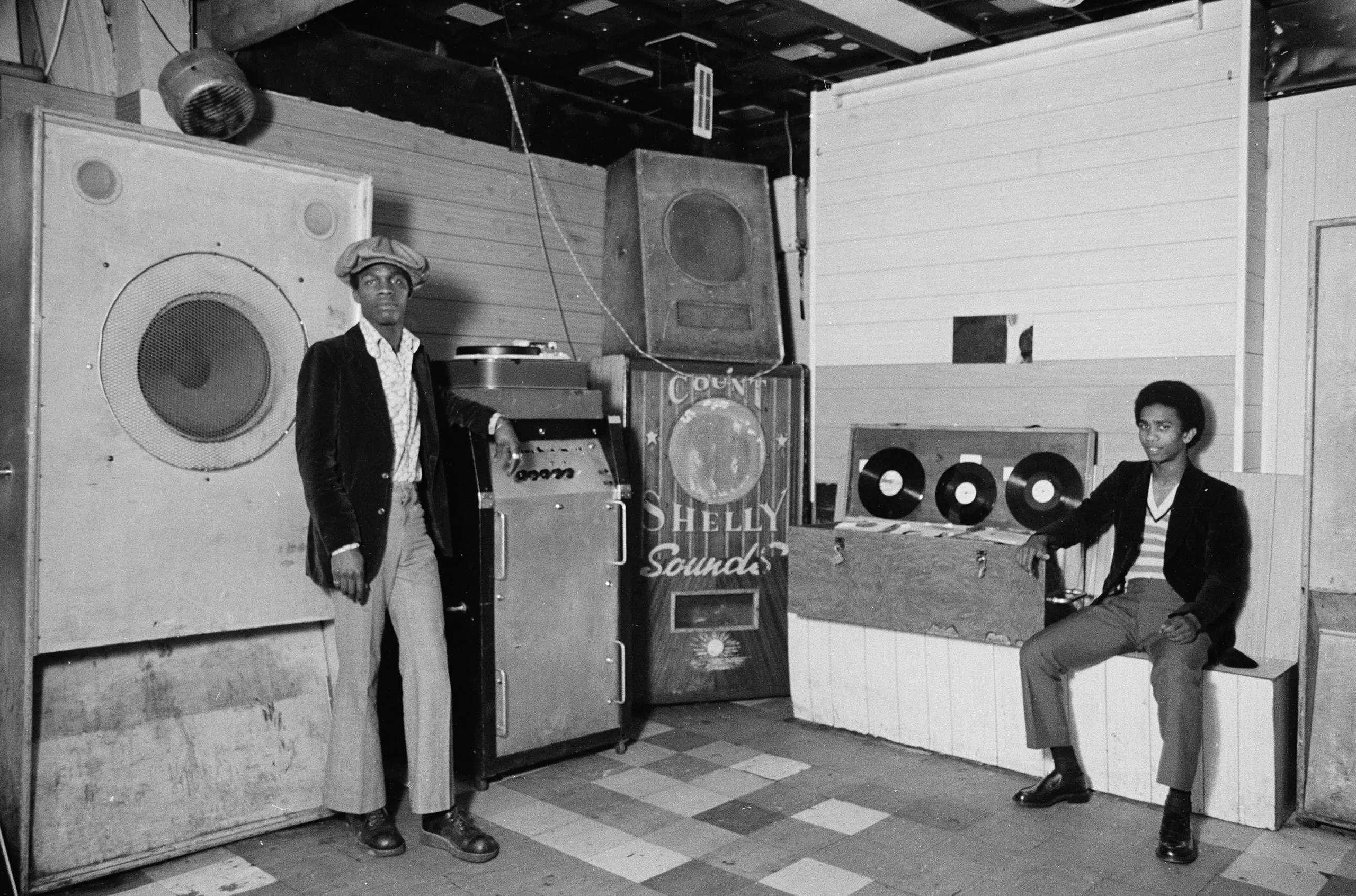
Dennis Morris, The Four Aces Club, Count Shelly Sounds, Hackney, London, 1973 © Dennis Morris
Transcript - Wedding in Hackney Town Hall
In this square black and white photograph, three members of a wedding party – bride, groom and, presumably his mother – stand behind a table set with a wedding cake and party food.
On the left-hand side of the photograph, the bride stands back against a wall, she's in her late-teens or early-twenties, with glowing dark skin and a short fringe, emerges from her veil, a cloud of white net embroidered with large daisies, and a high-necked dress of white broderie anglaise. With her head tilted down, she is looking off to the left, unsmiling, eyes expressing some unhappiness. In front of her is a white wedding cake with three tiers supported by white columns, a silver horseshoe on top. It’s just possible to make out the clasped hands of the bride and groom, half hidden behind a candlestick and a glass of champagne, although they are angled in opposite directions.
Standing in the centre, the groom is turning away from her to kiss his mother on the cheek. He’s a white man with a boyish look that suggests he’s the same age as his bride - although only his neck, one ear and the edge of a cleanshaven cheek are visible. He has neatly cut straight hair, and wears a dark pin-striped suit, white shirt and striped tie. He leans in towards the older white woman with tightly set curls and glasses in a smart dress and coat ensemble. Her head is tilted back, mouth set, and she holds a glass of wine in one hand, her other hand clenched at her waist. Just moving into the image, in the top right-hand corner a glass of red wine is raised in a toast, held by the hand of a man with dark skin. In front of her on the narrow table is a modest bouquet of carnations with a ‘Wedding Greetings’ telegram propped up against the vase.
The rest of the buffet table is covered with plates of party food on paper doilies – triangular sandwiches garnished with limp parsley, sausage rolls, rounds of cucumber and halved tomatoes, fairy cakes, slices of fruit cake and a plate of mixed biscuits.
The decision to photograph the group behind the buffet table gives the image a documentary feel, while the young woman’s gaze holds some mystery – is she meeting someone’s eyes just outside the frame? Does her expression suggest melancholy, or just a moment of fatigue after the ceremony?
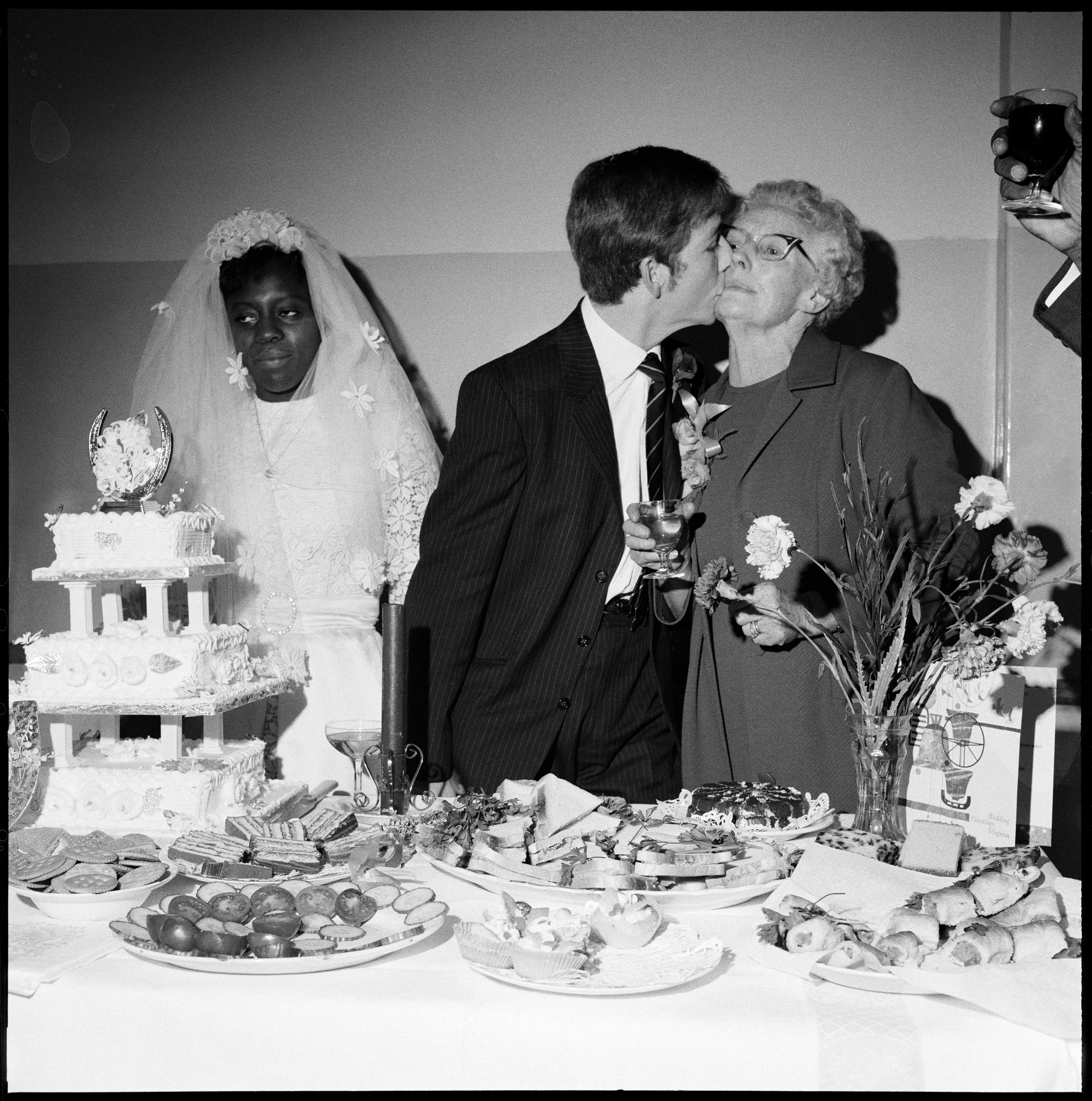
Dennis Morris, Wedding, Town Hall, Mare Street, London, 1971 © Dennis Morris
Transcript - A man with his two daughters and his most prized possession
A man sits on the edge of a bed, a daughter on either side, a portable radio cassette player on his lap. All three gaze seriously at us.
The man is broad-shouldered, in his thirties. He wears a Sikh turban, a dark suit with a white shirt open at the collar, and slip on leather shoes. His moustache is waxed into two points that lift upwards and he has a neatly trimmed beard, a silk scarf tucked into the neck of his shirt and a silver pen clipped into his jacket pocket. His hands rest on top of the upright silver and black radio cassette player that is balanced on his knees.
To the left is a girl of about five, hands folded in her lap. She seems to be wearing a loose tunic with a white lace yoke, her dark hair pulled back with a ribbon. She has striped socks and shoes with double buckles. To the right is an older girl in a pale jacket and dark trousers, with long socks and suede lace ups. Her hair is also drawn back with a bow at the back and her hands rest loosely on her knees.
The bed is an old-fashioned narrow double, high with a wooden headboard. The father sits comfortably on the edge but the children’s feet dangle. The bed is pushed against a wall with flowered wallpaper, with the door of the room to the right and barely enough room to open the doors of a large wardrobe to the left. A different patterned paper is on the other wall, with a tiled fireplace just visible at the left-hand edge.
Two pairs of shoes on the floor perhaps belong to other members of the family not in the picture – flipflops and a pair of small, buckled shoes. A cardboard fruit box on top of the wardrobe and three suitcases beneath the bed suggest this is home for now.
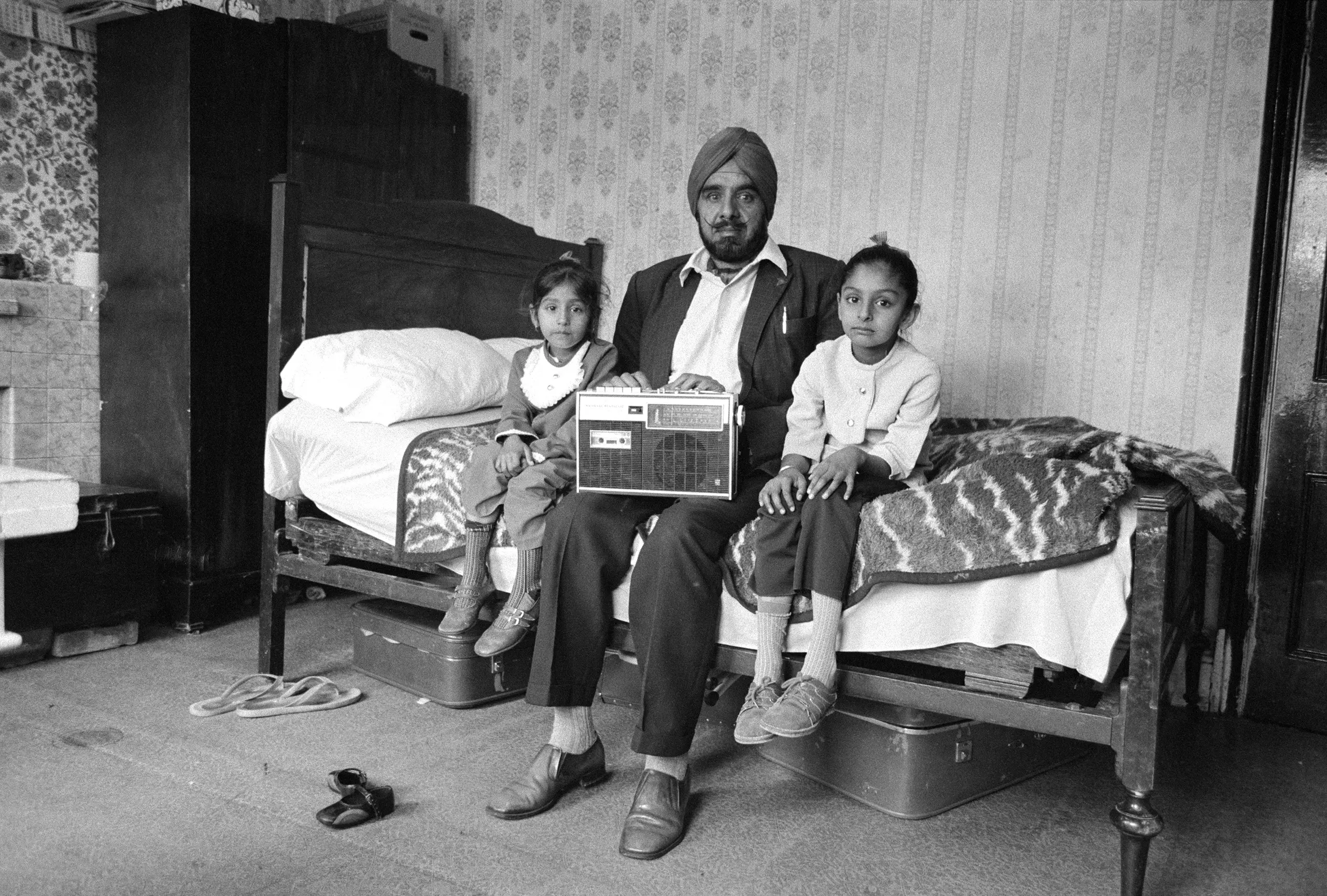
Dennis Morris, Man with his two daughters and his most prized possession, Southall, 1976 © Dennis Morris
Transcript - Gifts for the kids in Trenchtown
A young Bob Marley, not yet thirty, stands in a sport shop, looking down at a football in his hands. He’s wearing a zip up top over a black polo neck, with a woollen beanie pulled down over his locs. His long fingers hold the ball lightly in front of him, towards us, the crisp hexagons and pentagons of black and white leather at the lower edge of the photograph, the closest part of the scene to us. His expression is thoughtful, as if weighing up the quality of the ball, or considering how many footballs he'd like to buy to take back to Trenchtown, Jamaica.
In the background, there are racks holding more footballs, plastic wrapped tennis rackets hanging on the wall, and cardboard boxes leaned up against the sides as if there is stock to be unpacked.
At first glance, Marley seems to be on his own but two people can just be glimpsed at the edge of the frame – a slightly blurred dark-haired woman and someone holding sheets of paper, a lit cigarette between their fingers.
Football was a passion throughout Bob Marley’s life. When he moved to Trenchtown at the age of 12, he played for the tough Boys Town team. His tour manager throughout the 1970s was one of Jamaica’s most renowned soccer players, Alan ‘Skill’ Cole. And on tour Marley was renowned for keeping a ball in the tour bus, playing pick-up games whenever he had the chance.

Dennis Morris, Shopping for the Trenchtown kids, Leeds, UK, 1974 © Dennis Morris
Transcript - Sid Vicious and Johnny Rotten
This black and white photo shows Sid Vicious and Johnny Rotten facing the photographer against the background of Coventry bus station on a grey, overcast day.
Sid Vicious is facing us, head cocked to one side, eyes and mouth screwed up in a not unfriendly grimace. He’s about 20, his dark hair is spiky, his face pale. He wears a black leather jacket with zips open and badges including a skull and crossbones and a guitar. A chunky chain round his neck is secured with a padlock and he has a studded leather belt and wristlet. He is holding an open can of stout.
Beside Vicious, on the right-hand side of the photograph, Johnny Rotten is turned away, looking at something beyond the frame of the photo. He is about twenty and is wearing a heavy winter coat and a pith helmet – a brimmed hat worn by colonial soldiers – with the chin strap hanging behind his head. The two seem unconnected – Johnny could be a passerby.
Behind them, further back, a man in jeans and jean jacket stands on the wet cobbles, facing away from us, and there is a further group of people beyond him. The background is bleak – white flat roofs over the coach stances, and the darker grey concrete, streaked by rain, of a two-storey car park.
The English punk rock band, The Sex Pistols, formed in 1975. Dennis Morris spent a year documenting them, starting in May 1977. It was during this time that their only studio album, ‘Never Mind the Bollocks, Here’s the Sex Pistols’, was released. Close examination of the coach in the background of this photograph shows a label reading Film Service Transport, suggesting that this is more than a random moment at the bus station. S.P.O.T.S stood for Sex Pistols On Tour Secretly and was a tour of six venues under fake names, including ‘Acne Rabble’ and ‘A Mystery Band of International Repute’.
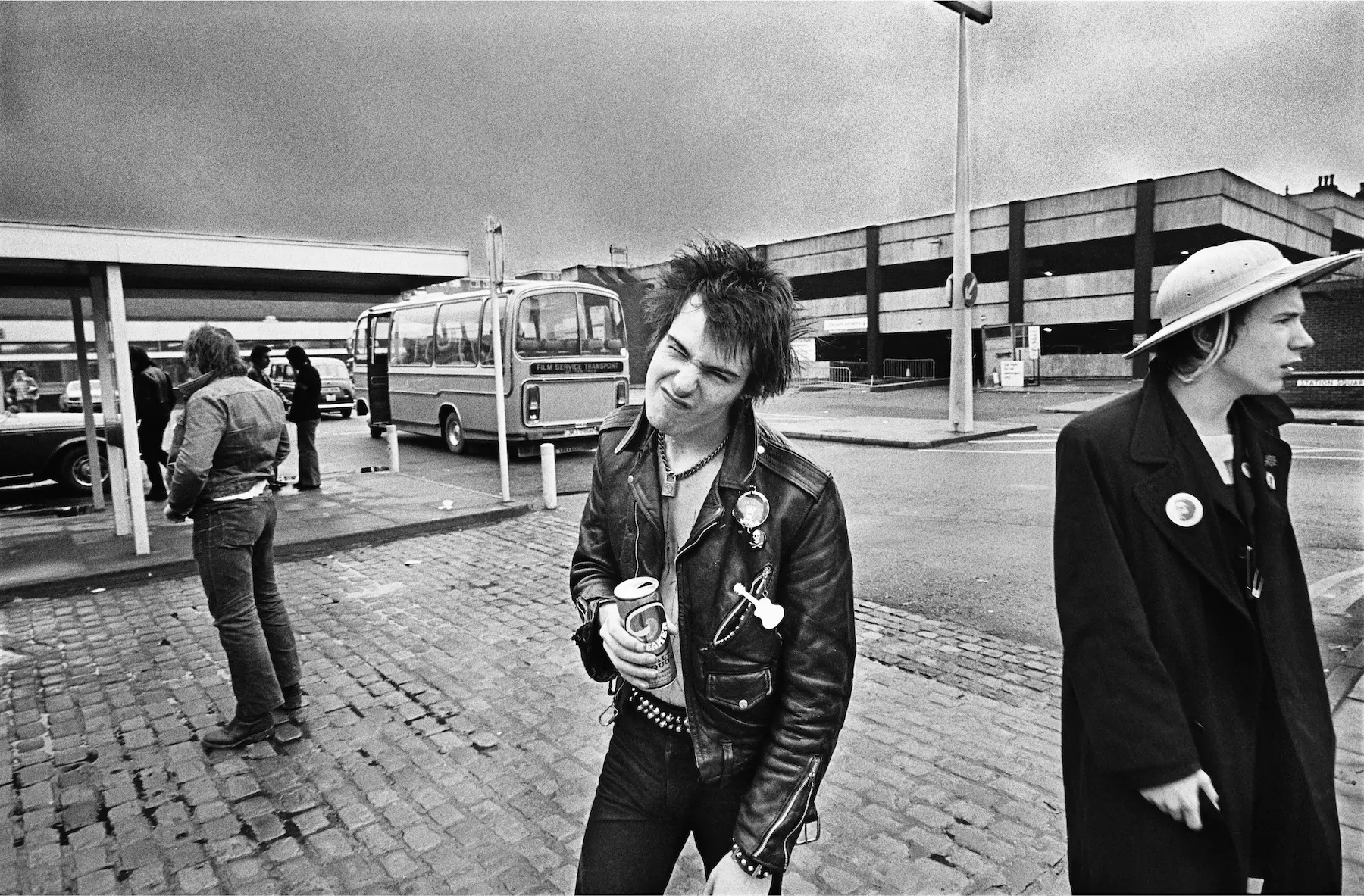
Dennis Morris, Sid Vicious and Johnny Rotten, S.P.O.T.S tour, Coventry station © Dennis Morris


